
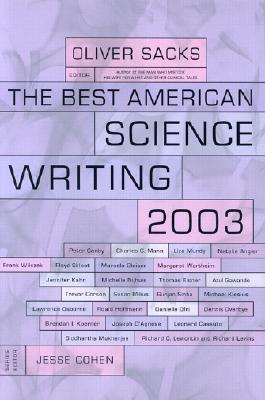
The Best American Science Writing
- Binding: Hardcover
- Publisher: Ecco
- Publish date: 09/01/2003
Description:
In his introduction to The Best American Science Writing 2003, Dr. Oliver Sacks, whom the "New York Times has called "the poet laureate of medicine," writes that "the best science writing ... cannot be completely 'objective' -- how can it be when science itself is so human an activity? -- but it is never self-indulgently subjective either. It is, at best, a wonderful fusion, as factual as a news report, as imaginative as a novel." It is with this definition of "good" science writing in mind that Dr. Sacks has selected the twenty-five extraordinary pieces that make up the latest installment of this acclaimed annual. This year, Peter Canby travels into the heart of remote Africa to track a remarkable population of elephants; Atul Gawande shows us the way doctors learn their skills by performing supposedly routine procedures on unsuspecting patients. With candor and tenderness, Floyd Sklootobserves the toll Alzheimer's disease is taking on his ninety-one-year-old mother, and is fascinated by the memories she retains. Marcelo Gleiser asks: If we are the universe's sole intelligent species, then what must we do to be good citizens of the cosmos? Natalie Angier writes about the challenge of traveling to distant stars. Gunjan Sinha explores the mating behavior of the common prairie vole and what it reveals about the human pattern of monogamy. Michael Klesius attempts to solve what Darwin called "an abominable mystery": How did flowers originate? Lawrence Osborne t
Expand description
Product notice
Returnable at the third party seller's discretion and may come without consumable supplements like access codes, CD's, or workbooks.


Please Wait