
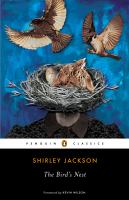
The Bird's Nest
- List Price: $17.00
- Binding: Paperback
- Publisher: Penguin Group (USA) Incorporated
- Publish date: 01/28/2014
Description:
FOREWORD Shirley Jackson was, and continues to be, one of my greatest influences, a writer who suggested a way to engage with the strangeness of the larger world and yet stay true to whatever complicated ideas I wanted to express. I first read "The Lottery" when I was a preteen, still one of the most transformative reading experiences of my life, which led me to Hangsaman and The Haunting of Hill House , then her earlier works, as I searched for every written word that Jackson created, and ended when I finally read, long overdue, We Have Always Lived in the Castle . Jackson has remained the writer I look to when I want to understand the darkness of the world and how human beings internalize that darkness or, perhaps even more terrifying, create it themselves. The larger world has always been difficult for me to process, a constant source of anxiety, and Jackson''s work gave me a blueprint for how I might navigate that world without succumbing to paranoia; her stories were cautionary tales in which I somehow lived comfortably. The Bird''s Nest , though written early in her career, showcases what I find so engaging about Jackson''s work: her ability to create situations of quiet chaos that, no matter how much the reader seeks to find a tangible explanation, defy our attempts to categorize or fully understand it. The world, I understood through Jackson''s novels, could never be fully explained, and it was in those mysterious places that resisted definition that offered the most interesting stories. * * * The Bird''s Nest opens on a building in need of repair, a museum that features an "odd, and disturbingly apparent, list to the west." When I reread this novel, the image immediately reminded me of Jackson''s exceptional later novels, We Have Always Lived in the Castle and The Haunting of Hill House , where the reader encounters ominous structures, domiciles that house strange and fascinating characters. A few pages into the story, we meet our main character, Elizabeth Richmond, a quiet, lonely young woman mourning the recent death of her mother, and we learn the possibility that "Elizabeth''s personal equilibrium was set off balance by the slant of the office floor" of the museum, where she works in the clerical department. Elizabeth''s office is on the highest floor of the museum and now, thanks to the renovation project, offers an open hole in the wall next to her desk that exposes "the innermost skeleton of the building" and induces the temptation to "hurl herself downward into the primeval sands upon which the museum presumably stood." For those of us who love Jackson''s work, this is familiar territory, and we are prepared for the listing structure to slowly drive Miss Richmond mad. Darkness enters the narrative when we learn that she is receiving threatening letters that exacerbate her recurring headaches and back pain. All of the elements are now in place and then, a testament to Jackson''s genius and a reason why The Bird''s Nest remains one of my favorite novels, Jackson shifts the narrative into a new and altogether more interesting direction. Elizabeth Richmond possesses multiple personalities, one of which leads her to sneak out of the house she shares with her aunt and into all manner of unsavory activities. The threatening letters have no source other than Elizabeth''s own hand. She admits to being unaware of these terrible events, but she can''t be sure. We now see that the structure housing strange and fascinating characters is not the museum but, rather, Elizabeth''s own body. And thus we discover the true focus of Jackson''s genius: the mysterious contents within all of us, the self-destructive tendencies that threaten to ruin the structure that keeps them hidden from the rest of the world. * * * As we leave the museum behind and enter into the unique workings of Elizabeth''s mind, the story becomes an examination of mental illness, the darkness inside us that we struggle to understand and keep at bay. Like Constance in We Have Always Lived in the Castle , Eleanor of The Haunting of Hill House , and Natalie of Hangsaman , Elizabeth is a fragile, isolated young woman, but Jackson experiments with voice by revealing each distinctive personality, each one broken in some unique way. While sections of the novel are given over to Elizabeth''s sometimes unwilling psychiatrist, Dr. Wright, and her aunt Morgen, who possesses her own secrets, my favorite passages focus on the difficult inner workings of the mind of Elizabeth, or whichever personality currently inhabits her form. Jackson has always written with such precision about the delicate nature of our psyches, and as someone who has struggled with mental illness for my entire adult life, I think that there are few writers who know the ways in which our minds betray us as well as she does. When Betsy, Elizabeth''s most problematic and difficult personality, sneaks away from the care of Dr. Wright and Aunt Morgen to run off to New York in search of the mother she believes is still alive, the novel becomes electric and disturbing; it is hard to tell exactly what is happening, as Betsy''s thought processes are jumbled, but the world becomes a dangerous place, every human interaction fraught with the possibility of violence, every landmark simply another space that remains unknown to Betsy. It is some of the most thrilling and terrifying writing found in any of Jackson''s work. While the good doctor''s work with Elizabeth, especially his use of hypnosis to treat multiple personalities, might provide the occasional breakthrough, I don''t believe Jackson intends to suggest that he truly holds sway over the bottomless depths of Elizabeth''s own mysterious desires and behaviors. The doctor in fact has an edge of something ominous in his own manner, played nicely against his self-deprecating humor. His interior complications explain his horror when he is confronted with the true nature of Elizabeth''s darkness. The doctor is merely a lion tamer attempting to subdue the human psyche, and one can''t help inferring Jackson''s opinion on the lasting success of domesticating such a wild animal. While the book ends with the suggestion of happiness, or at least temporary calm, there is no happy ending. The threat of the world around us and the even more potent threats inside us cannot offer much in the way of happiness. Elizabeth, whatever her fate, is a sympathetic character, entirely human in her desires and actions, however strange they might be. This explains why, much like The Bird''s Nest itself and, in fact, all of Jackson''s work, it is so unsettling to see the darkness and chaos beneath the surface. We encounter a world where, thanks to Jackson''s talent, we recoil from the danger and then move closer to see it more clearly. KEVIN WILSON 1 ELIZABETH Although the museum was well known to be a seat of enormous learning, its foundations had begun to sag. This produced in the building an odd, and disturbingly apparent, list to the west, and in the daughters of the town, whose energetic borrowings had raised the funds to sustain the museum, infinite shame and a tendency to blame one another. It was at the same time a cause of much amusement among the museum personnel, whose several vocations were most immediately affected by the decided slant given to the floors of their building. The proprietor of the dinosaur was, as a matter of fact, very humorous about the almost foetal tilt of his august bones, and the numismatist, whose specimens tended to slide together and jar one another, was heard to remark--almost to tedium--upon the classical juxtapositions thus achieved. The stuffed bird man and the astronomer, whose lives were spent in any case almost out of earthly equilibrium, professed themselves unaffected by the drop of one side of the building, unless driven toward a kind of banking curve to offset the natural results of walking on tipped floors; walking was, in any case, an unfamiliar movement to either of them, one tending toward flight and the other toward the complacent whirling of the spheres. The very learned professor of archeology, going inattentively along the slanted corridors, had been seen hopefully contemplating the buckled foundations. The contractor and the architect, along with the ill-tempered daughters of the town, endeavored to blame first the inefficient materials supplied for the building and second the extraordinary weight of some of the antiquities contained therein; the local paper printed an editorial criticizing the museum authorities for allowing a meteor and a mineral collection and an entire arsenal from the Civil War, dug up just outside of town and including two cannon, to be lodged all on the west side of the building; the editorial pointed out soberly that, had the exhibit of famous signatures, and of local costume through the ages, been settled on the west side, the building might not have sagged, or might at least not have done so during the lifetimes of its sponsors. Since the local paper--current and impermanent--was not permitted below the third, or clerical, floor of the museum, the exhibits were allowed to retain their impractical arrangements unmoved by the editorials, although the clerical employees on the third floor read the comics daily and studied the front pages hoping to discover the manners of their deaths. They were given, on the third floor, to meditation, and they believed almost everything they read. In this, of course, they differed in almost no way from the educated inhabitants of the first and second floors who dwelt among unperishing remnants of the past, and made little wry jokes about disintegration. * * * Elizabeth Richmond had a corner of an office on the third flo it was
Expand description
Product notice
Returnable at the third party seller's discretion and may come without consumable supplements like access codes, CD's, or workbooks.


Please Wait