
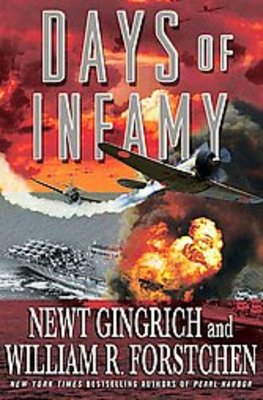
Days of Infamy
- List Price: $27.95
- Publisher: St. Martin's Press
- Publish date: 05/06/2008
Description:
Chapter One The White House December 7, 1941 19:45 hrs E.S.T. PRESIDENT FRANKLIN DELANO Roosevelt looked up from the text of his speech as General George Marshall stood at the doorway, a flimsy sheet of telex printout clutched in his hand. The President turned back to Missy LeHand, his secretary, pointing out where he had just crossed out a line for the address he was preparing for the nation, now scheduled for noon tomorrow before a joint session of Congress. "Here, put this in the first sentence," and he pointed to his margin notes, " 'a date which will live in infamy.' " She nodded in agreement. He now focused his attention on his Army chief of staff. "What do you have for us?" "This just came in, Mr. President," and Marshall stepped into the room, unfolding the telex sheet and handing it to him. "It reports that a third strike wave of at least seventy Japanese aircraft is attacking Pearl Harbor. The line went dead approximately ten minutes ago." The President scanned the few brief lines: "Oil tank farms struck. Fires out of control. Harbor channel blocked. Preparing to face invasion. . . ." The message stopped in midsentence. The President crumpled the report up, ready to angrily toss it on the floor by the side of his wheelchair, but then thought again. It was a document now, a moment of history, and he instead tossed it onto his desk, to be filed away for later. Attack the United States, would they? On our own soil? Without a declaration of war? He thought about this dastardly sneak attack. What could this ever be compared to? Even when the British attacked and burned Washington and this very building to the ground, we knew we'd survive. Could this onslaught be but the beginning? Hitler was at the gates of Moscow. Might the Japanese turn on the Soviets as well, together those two dark powers finish off Stalin and then fling their entire fury at England and then us? It was sobering to be the President presiding over the crisis of Western civilization and its death struggle with the forces of modern evil in both Europe and Asia. Our civilization must not lose this war, or it would be, indeed, as Winston Churchill said, "a thousand years of darkness." No, never think about the possibility of defeat, he thought to himself. If I allow that thought ever to take hold, it could permeate down across the entire nation. If ever America, if ever the entire free world, needed leadership that showed not just righteous anger, but also a firm, calm resolve that inevitable victory would come, it was now. Being an optimist was a trait he had acquired at Warm Springs, Georgia, when everyone else thought he should relax and accept that polio had crippled him and ended his political life. If he had given in eighteen years earlier, he would not be in the White House looking at General Marshall and dictating his most important speech to Congress. No, he thought to himself, these Japanese will not turn me to thoughts of defeat, and neither will Herr Hitler. They have given us the possibility of bringing to bear the full force of our great people and the full resources of our great nation and now, after three years of quiet sustained effort, our preparedness program will show its results. That strength had to be aroused through words. Words often meant more than ships and planes and tanks. It was words that aroused a people and focused a nation. He thought of his good friend across the Atlantic with fondness for his inspiring courage and language. Though some of the more effete and cynical still privately shook their heads about Winston Churchill's posturing and rhetoric, there would never be a denial that the strength of his words and his pugnacious defiance were worth as much as an entire army in the field and had braced England in the darkest days of its long history. I must do the same. I must be the war President. I must lead. If I show weakness now, even for a moment, then surely darkness will triumph. In fact I must become the President of inevitable victory transcending the war. He stirred from his thoughts and looked back at Marshall, who stood silent by the doorway into his office. "Anything else?" the President asked, fixing Marshall with his gaze. "Not much, sir. Most cable links to Hawaii are down. Apparently the terminus on Oahu was damaged. Our Army radio monitoring at the Presidio in San Francisco reports that it can still pick up a civilian station that is frantically calling for volunteers to donate blood, and for anyone with medical training to report to the nearest military base. World War One veterans with combat experience are to report, too. The Lightning Division and national guard units are mobilizing and preparing to repel any landing attempts, but it is still too early to tell what's really happening. "Other than that, sir, we are in the dark." "Have you talked to Admiral Stark?" "Yes, sir. I must say he is still in shock. It is his fleet that has taken the brunt of the immediate punishment. The only good news is this: Our two carriers still based at Pearl Harbor were out to sea and for the moment are assumed to be safe." "Where are they now?" "Halsey with Enterprise is believed to be somewhere southwest of Oahu. Lexington unfortunately is not in mutual support ran it is more than seven hundred miles to the northwest of Enterprise. They could hardly have been assigned farther apart. It was just random chance, sir, call it good luck or bad, with Halsey inbound after dropping planes off at Wake Island and Newton on Lexington outbound to Midway on the same mission. I just thank God they were not in the harbor this morning, which has usually been the typical routine." Roosevelt, a sailor and former undersecretary of the Navy, could picture the scenario and already had the potential answer. Along with Enterprise and Lexington being out at sea, a month back Saratoga had secretly transited back to the West Coast, for a refit in Bremerton, Washington, and was just preparing to head back out to Oahu. As Marshall had just voiced, thank God the timing of all this regarding the aircraft carriers had worked out as it did, otherwise they would be burned-out hulks resting in the mud and flames of Pearl Harbor, along with the battleships. "Do we even have a remote idea as to the size of the Japanese fleet that hit us?" Roosevelt asked. Marshall shook his head. "Apparently no one has yet organized a proper search. It could be four of their carriers; Admiral Stark thinks maybe five or six. There is no clear indication. We don't even know what direction they came from." The President grunted at the lack of intelligence and analysis. "Surely we must do better than that," he said to General Marshall, "and quickly." One of the first priorities would be to get Yorktown and Hornet transferred out to the Pacific. Together, five carriers could be a potent match-up with the Japanese-if Enterprise and Lexington survived the next few days. That was a very big if. He considered the distances, the obvious aggressiveness of the Japanese attack force. If he could step inside the mind of their admiral in command, whoever he was, chances were he would not be satisfied with the destruction inflicted so far. The third strike was proving that. A more timid soul would have made the surprise attacks of the morning and then pulled out. This opponent was in it for the kill. "The Japs could move between our two carriers out there and finish each off in turn." "If their continued aggressiveness is any indication." Marshall hesitated. "I am not a naval officer, sir, but yes, that would be my assessment." "I want those carriers to hit back, and hit them hard," the President replied sharply. "If whoever launched this attack wishes to seek out our carriers, I expect ours not to turn tail and run, but to fight," and he slapped the sides of his wheelchair. "To fight them, by God, and show them from the start that we intend to punch back." "I know Admiral Halsey, sir," Marshall said quietly. "I think that is a foregone conclusion." The President nodded. He reached into his breast pocket, opened his cigarette case, inserted one into its holder, and lit it. Never in the history of American arms, in the history of the United States Navy, had such a defeat been dealt. Perhaps in the war against the Barbary pirates, when America's only ship of the line, Philadelphia, had been lost, but not eight capital ships in one morning. And it was on his watch. Now two carriers and what was left of the shattered fleet in Pearl, along with a couple of small task groups led by cruisers luckily out to sea as well this morning, were the only tools left to try and balance the ledger of this grim and terrible day. Later, thanks to the massive building program he and Carl Vinson had pushed through Congress during peacetime, there would be more than enough ships and planes. Last year he had called for fifty thousand planes to be built, more aircraft than existed in all the air forces of all the other nations now in this war. The factories to build them were still under construction, but soon the strength of America, would start to pour warplanes forth from those factories. Already tens of thousands of young men were in training to fly those planes yet to be built. Come autumn of next year, a new fleet carrier would be sliding down the ways each month. Battleships, cruisers, destroyers, and submarines by the hundreds were under construction even now. But those forces were more than a year off. In the meantime, what can the Japanese, who have been preparing for years for this moment, do to us? Perhaps s
Expand description
Product notice
Returnable at the third party seller's discretion and may come without consumable supplements like access codes, CD's, or workbooks.
| Seller | Condition | Comments | Price |
|
Goodwill
|
Good |
$1.11
|
|
Off The Shelf
|
Good

|
$2.13
|
|
Blue Vase Books
|
Good
|
$4.08
|
|
Used Book Company
|
Good
|
$4.12
|
|
Redux Books
|
Like New
|
$5.20
|
|
HPB-Diamond
|
Very Good
|
$5.33
|
|
HPB-Movies
|
Very Good
|
$5.62
|
|
HPB-Emerald
|
Very Good
|
$5.62
|
|
HPB-Diamond
|
Very Good
|
$5.62
|
|
HPB Inc.
|
Very Good
|
$5.62
|
|
Half Price Books Inc
|
Very Good
|
$5.62
|
|
HPB Inc.
|
Very Good
|
$5.90
|
|
Half Price Books Inc
|
Very Good
|
$5.90
|
|
Orphans Treasure Box
|
Like New
|
$6.10
|
|
Books End Bookshop
|
Very Good |
$6.18
|
|
BooksRun
|
Good
|
$6.22
|
|
HPB Inc.
|
Very Good
|
$7.30
|
|
Inga's Original Choices
|
Like New
|
$7.87
|
|
Jeff Stark
|
Like New
|
$7.87
|

Please Wait