
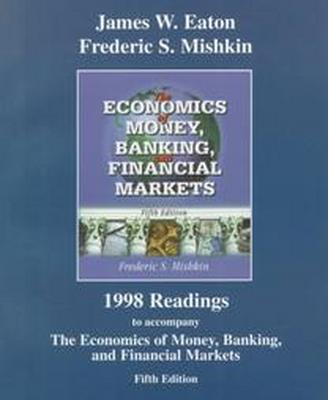
1998 Readings T/A Economics of Money, Banking, and Financial Markets 5e
- List Price: $30.40
- Binding: Paperback
- Edition: 0005
- Publisher: Addison-Wesley Educational Publishers
- Publish date: 12/08/1997
Description:
I. INTRODUCTION. Reading 1: The Money Market. Reading 2: Logging on to Electronic Means of Payment. Reading 3: The Changing Meaning of Money. II. FINANCIAL MARKETS. Reading 4: Adding Duration to the Toolbox. Reading 5: The Name Is Bond-Indexed Bond. Reading 6: The Yield Curve as a Predictor of U.S. Recessions. Reading 7: Big MacCurrencies. Reading 8: Budget Deficit Cuts and the Dollar. III. FINANCIAL INSTITUTIONS. Reading 9: A Look at America's Corporate Finance Markets. Reading 10: For Better and For Worse: Three LendingRelationships. Reading 11: Financial Fragility and the Lender of Last Resort. Reading 12: Bad Debt Rising. Reading 13: Loan Lending Magic. Reading 14: Efficiency of U.S. Banking Firms-An Overview. Reading 15: Small Business Lending and Bank Consolidation: IsThere Cause for Concern? Reading 16: Bank Branches in Supermarkets. Reading 17: Cracking the Glass-Steagall Barriers. IV. CENTRAL BANKING AND THE CONDUCT OF MONETARY POLICY. Reading 18: Central Banking in a Democracy. Reading 19: Why Central Bank Independence Helps to MitigateInflationary Bias. Reading 20: Fed's Huge Empire, Set Up Years Ago, is Costly andInefficient. Reading 21: Where is All the U.S. Currency Hiding? Reading 22: Falling Reserve Balances and the Federal FundsRate. Reading 23: Never Mind Those Ms. Reading 24: Inflation Targeting: A New Framework for MonetaryPolicy? Reading 25: A Predictable and Avoidable Mexican Meltdown. Reading 26: Mexico's Liquidity-Driven Financial Panic. Reading 27: The EMU: A Groundbreaking Monetary Experiment. V. MONETARY THEORY. Reading 28: Nobel Views on Inflation and Unemployment. Reading 29: Monetary Policy and Real Economic Growth. Reading 30: What Causes Inflation? Reading 31: Stock Market Fundamentals. Reading 32: Activist Monetary Policy for Good or Evil? The NewKeynesians vs. the New Classicals.
Expand description

Please Wait