
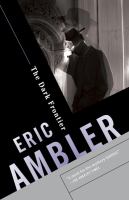
The Dark Frontier
- List Price: $18.00
- Binding: Paperback
- Publisher: Knopf Doubleday Publishing Group
- Publish date: 12/11/2012
Description:
PART ONE The Man Who Changed His Mind Chapter 1 April 17th By half-past twelve, Professor Barstow was feeling tired. He had already driven one hundred and eighty miles that day. It was with a sigh of relief that, some three-quarters of an hour later, he turned his car into the courtyard of the Royal Crown Hotel at Launceston. He alighted, stretched himself and, with methodical care, locked the doors. Then he checked each one. Professor Barstow did everything methodically, whether it was applying the laws of electrodynamics to a case of electronic aberration or combing his Blue Persian cat. His very appearance spelt order. His lean, sallow face, his firm lips pursed judicially and his neat dark grey suit expressed with quiet eloquence the precision of his habits. His lectures before the Royal Society were noted and respected for their dispassionate reviews of fact and their cautious admissions of theory. "Barstow," an eminent biologist once declared, "would be a genius if he wasn''t so afraid of his own thoughts." Which remark, following closely, as it did, upon the publication of Barstow''s critical study of the Lorentz transformations, was, to say the least of it, surprising. The truth of the matter is, perhaps, that he distrusted his imagination because it told him things he did not wish to believe. At that moment, he was distrusting it with more than ordinary force for it was telling him something he did not want to believe; namely, that he was a sick man who should be dozing peacefully on the verandah of a spa hotel, not careering up and down precipitous hills at the wheel of his car. He dismissed this notion firmly, went into the hotel and ordered a well-done steak. While it was being grilled he sipped at a glass of sherry. It was, he reflected, a long time since he had had a holiday. And then, for no apparent reason, he suddenly found himself thinking of long-forgotten Cambridge days and of another spring when he had almost decided to abandon his brilliant promise as a physicist and try for "the diplomatic." Queer, now he came to think of it. He''d been feeling very much the same then as he did now. That was the year he''d read so hard for the math tripos. Fifteen hours a day he''d been putting in; far too much for a youngster. No wonder he''d nearly cracked up; no wonder the diplomatic had looked so attractive all of a sudden. But then he''d always had a fancy for it. His day-dreaming had always been of statesmanship behind the scenes with himself as the presiding genius, of secret treaties and rapprochements, of curtain intrigue conducted to the strains of Mozart, Gluck and Strauss, with Talleyrand and Metternich hovering in the background. Queer, too, how dreams of that sort stayed with you. One half of your brain became an inspired reasoning machine, while the other wandered over dark frontiers into strange countries where adventure, romance and sudden death lay in wait for the traveller. Not that there would have been much adventure or sudden death in a diplomatic career--he knew that well enough now--while it had been romance, disguised as the middle-aged wife of his father''s junior partner, that had sent him back to work nursing an undeclared and hopeless passion. It had endured, he remembered now, for less than a week. He sighed. He was still considering the pallor of his youthful follies when he took his seat in the dining-room. He ate his steak slowly. The room was empty with the exception of himself and a plump white-haired man whom he did not notice particularly until, glancing up from his plate, he was surprised to find himself the object of a fixed stare. "A lovely day, sir," remarked the white-haired man as their eyes met. "Yes," said Professor Barstow, and then, not wishing to appear brusque, "Yes, very." He always felt a little ill at ease when addressed by strangers and made no attempt to continue the conversation. But the white-haired man was persistent. "Are you staying in Launceston, sir?" Professor Barstow shook his head. "I''m going on to Truro," he said. "You are staying in the hotel?" he countered politely. The white-haired man nodded absently. Then, with a sudden air of decision, he moved his chair nearer to Professor Barstow''s table and leant forward earnestly. "Six months ago I was in China. Before that I was in South America. Before that, I was in Turkey. For six years I''ve been out of England. For six years I''ve been looking forward to the time when I could come home and settle down. Now I am home, and what do I find?" Professor Barstow, his interest only faintly aroused, shook his head gravely. He had decided that the man must be a travelling salesman of some sort. They were notoriously talkative. The white-haired man sipped at his coffee dramatically. "Nothing," he said, "absolutely nothing! I''ve been home a month now. For the first three days the sight of green fields and clipped hedges excited me. Now it bores me. All I find is a particularly venomous species of Egyptian mosquito and a landscape of petrol pumps." "Surely you exaggerate a little?" "Perhaps I do," answered the other gloomily, "but when you have been nourishing your soul on expectation, reality is apt to be disappointing." Dismayed by the emotional trend of the conversation, the Professor hastened to divert it. "You have retired?" The white-haired man looked at him for a moment before replying. The Professor was an unimpressionable man, but it occurred to him that his first estimate of his companion was certainly wrong. His plump geniality had deserted him. A pair of cold, calculating eyes stared unblinkingly from below the bushy white eyebrows. Their owner ignored the question. "Tell me, sir," he said thoughtfully. "I feel sure that I have seen your face before somewhere." The Professor felt rather than saw the cold eyes fixed upon him as he answered. "About a year ago," he said, "I became, for the space of two days, what the newspapers are pleased to call ''news.'' My photograph was blazoned about the press in the most embarrassing fashion." The white-haired man recovered his lost geniality like magic. "I knew it! I knew it!" He slapped his knee triumphantly. "I never forget a face, but the name sometimes eludes me. Just a minute, just a minute, don''t tell me," he went on as the Professor opened his mouth to speak, "the name, let me see . . . the name is . . . Barstow . . . Professor Barstow." "You have an amazingly good memory, sir." "Cultivated, Professor, cultivated," chuckled the white-haired man. He regarded the Professor with renewed interest. "If I remember rightly," he said, "you caused quite a commotion by announcing that atomic energy would shortly be harnessed for the uses and abuses of mankind, or words to that effect." "I did nothing of the kind," protested the Professor irritably. "The statement I made before the British Association has been grossly misrepresented. All I said was that important developments in the hitherto unexplored field of applied atomic energy might prove to be mixed blessings; a mild speculation on my part upon which the most sensational constructions have been placed." His companion, who had drawn his chair right up to the Professor''s table, was following him with close attention. "An amazing coincidence, amazing," he murmured with apparent irrelevance; then, "Professor, I should be honoured if you would take a liqueur with me." The Professor accepted without hesitation. His experience with the newspapers still rankled and he was glad of this opportunity to explain himself to such a sympathetic audience. For a time their conversation became general. The white-haired man''s name, the Professor discovered, was Simon Groom. He talked fluently and incessantly. His knowledge of foreign affairs was remarkable. The Professor, an assiduous reader of the Times foreign page, heard for the first time of a major crisis just past. The facts were stated with an easy familiarity that left no room for doubt. He found himself speculating on the nature of Simon Groom''s mysterious profession. The problem was soon to be solved. Groom steered the conversation once more to the subject of the Professor''s work. "You know, Professor," he began, cutting the end of his cigar carefully, "you know, I can''t help thinking that when you made that reference in your lecture to the fact that atomic energy in harness might prove a mixed blessing, the sensational aspect of the point was not entirely absent from your mind." He leant back and regarded the Professor quizzically. The Professor was silent. The first thought that came to his mind was that this Groom was yet another of those confounded reporters trying to trap him into an admission. For the hundredth time he cursed the impulse of a year ago which had led him from the firm paths of facts to the slippery slopes of prediction. "Mr. Groom," he said stiffly, "I am not prepared to add anything to my original remarks. The whole thing is regrettable and most distasteful to me." His companion was unabashed. He smiled and withdrew his cigar from his mouth. "Professor, I apologise. I should have stated the reason for my question. Chance has brought me into contact with the one man whose help I need. Let me explain." Without waiting for the Professor to speak, he continued: "Have you ever heard of
Expand description

Please Wait