
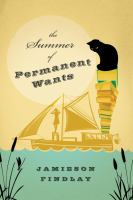
The Summer of Permanent Wants
- Binding: Paperback
- Publisher: Doubleday Canada, Limited
- Publish date: 05/03/2011
Description:
No sailor would have called Permanent Wants graceful or sea-kindly, but the crickets liked it well enough. They didn''t seem to notice it was a boat. To them, it was just a floating patch of backyard, free of toads and mantises and other enemies, and moated with stars on a fine night. There were two crickets, Cass and Nova. Emmeline had got the idea of bringing them on board after hearing about the legendary Joshua Slocum, author of Sailing Alone Around the World , who had once brought two crickets and a tree crab on board his boat. Several people had warned Emmeline that the chirping of crickets might get very tiresome after a while, but everybody agreed that crickets were a better idea than crabs. So on the night before the sailing of Permanent Wants , she went out into the long grass behind her house and caught two crickets. Into a jar they went, a very large jar--really a transparent world. It had grass and earth in the bottom, air holes in the lid, and sections of egg carton in the corner. The crickets must have felt right at home, for on the first night aboard, they started up their singing at around nine o''clock. Lafcadio, the shipboard cat, pricked up his ears in disbelief when he heard them. He probably wondered what kind of strange, cross-grained, weather-beaten, gone-to-seed, lumpish misfit of a broken-down hobo boat he was sailing on. It would not be the last time he would wonder that. This old but ardent vessel belonged to Emmeline''s grandmother, Mrs. Teolani McHovec. Mrs. McHovec ("Gran" to eleven-year-old Emmeli "Teo" to her friends) was sixty-four years old. She had short silver hair and eyes the colour of seawater fl owing over an iceberg. She loved wind. Had she been born during the Middle Ages, she might have been one of those witches who caught wind, tied it up in knots of rope, and then sold the knotted rope to sailors. But she was born much later, and so she just did a lot of sports that used wind. She had fl own glider planes in her youth, and now she sailed keelboats and flew kites. Her friend Picardy Bob, who loved danger as much as the crickets loved night music, had tried to get her to go hang-gliding once, but she said no. "That is a wild and irresponsible suggestion," she told him, "even for a former forger." I should describe Picardy Bob at once, before he is arrested. He is a small, friendly-fierce man, gifted at adventure and bicycle repair. Though he doesn''t look it, he is actually a few years older than Gran. He wears his long grey hair in a ponytail and once won a prize at a local fair for the magnificence of his moustache. At the time of this story, he was a book scout--that is, somebody who hunts down valuable old books for dealers and private buyers. He was very good at picking out genuine rare volumes from fakes, which wasn''t surprising, given his background. Years before, when he was living in England, he had actually forged a rare book himself. He did it out of curiosity and then decided that the experiment wouldn''t be complete unless he actually tried to sell the book, and . . . well, this is how criminal careers are made. He had served time for his crimes, and afterwards, back in Canada, he had decided to get into the book business. He always had piles of old books in the shed behind his little trailer, where he lived with a parrot named Django and a pug dog named Holden Caulfield. The adventure of Permanent Wants really began with Picardy Bob, and it happened this way. One day Bob was in his shed, sorting through boxes of books, when Emmeline and her grandmother visited him with some exciting news: Gran had inherited a boat from a distant cousin! And what a homely old boat it was. Gran had taken one look at it and decided that it should really go into some kind of home. It was broad and battered and peeling, with a low cabin and a rounded bow like a tug''s. The engine was an ancient diesel inboard that hadn''t worked in years. As a joke (apparently), somebody had plunked down a mast right in front of the cabin. "A barge with a sail" was Gran''s description of it. What could you possibly do with a boat like that? She put this question to Picardy Bob while he was sifting through his books, and--perhaps because he wasn''t getting much work done that day--he replied shortly: "I''ll tell you what you can do, Teo dear. Take some of my paperbacks here, put ''em on your big, ugly boat, and take a trip down the Rideau Canal Waterway. You''ll be the first floating bookstore in Cottage Country. They''ll love you." There was a silence. Even Django was silent. Emmeline gave her grandmother a long, eager blue-water look. "Don''t be a romantic fool, Bob," said Gran. "There''s no space on a boat for books." Picardy Bob plucked impatiently at his moustache. "I used to know a bookseller in London who hauled around his stock on a bicycle . He had a little trailer full of paperbacks and miniature books, and he did a brisk business at lunch hour. Sure, you could make a boat into a secondhand bookstore. And you''re the one to do it, Teo. Who here is always talking about the Strange Untried, the Unshored?" "That would be you, Bob." This was true. Picardy Bob often spoke about the Strange Untried, the Unshored, whenever he wanted Gran to go hang-gliding or something like that. (The phrase came from one of his favourite books, Moby Dick .) But deep down, Gran understood his love of adventure. Her late husband, Silas, had believed that everyone should have a half-decent adventure every two years--more often if you lived in Ottawa. And she herself was long overdue. Her last adventure was twelve years before, when she and Silas had sailed halfway around the world in their sloop, the Cygnus . That winter, without telling anyone, she began work on the boat. She scraped and painted the hull. She polished the metal fixtures, taking special care with the quaint stern lamp. She found a mechanic to fix up the engine. (As a lover of wind, she disliked engines, but she knew she couldn''t do without one.) And gradually she discovered the attractions of this strange, ugly fl at-bottomed vessel. Its ancestors were clearly the old canal boats and sailing barges of England and Holland. It had no keel, but rather two leeboards--large, broad wooden paddles attached to the sides of the boat. They looked something like the blunt, powerful flippers of a right whale. The leeboards could be lowered into the water to keep the vessel steady while under sail. Gran also discovered that the mast itself could be raised and lowered using an anchor winch. This meant that you could easily get the boat under a low bridge if you had to. All these features, along with its fl at bottom, made it the perfect waterway boat. When Gran found herself thumbing through the IKEA catalogue, looking for stackable bookshelves, she realized that the project had captured her completely. She wondered what kind of permit she would need to moor at public docks and sell books. But her last task was the most difficult--to convince her daughter, Emmeline''s mother, to let the girl go along. Emmeline''s mother had serious doubts about the voyage. She thought that Permanent Wants was far too big a boat to be handled by a grandmother and an eleven-year-old girl. "And this idea of selling books ," she said one evening, when Emmeline was upstairs practising her violin. "That means a till on board, which means cash, which means an open invitation to every lowlife from here to Joyceville." "Dear, you are forgetting that I sailed the South China Sea," said Gran. "The pirates there were thicker than flying fish." "But Dad was with you!" objected her daughter. "Well, this time Lafcadio the cat is with me." Her daughter said something like puh and frowned. She had no time for the Strange Untried. "Anyway," added Gran pacifically, "we can always pack a slingshot." Emmeline''s father now entered the discussion. "If the goal of this voyage," he said, "is to bring culture to the heathen cottagers and civilization to the land of the satellite dish, then I think a slingshot would be incompatible with your intentions. I suggest bear spray." "Don''t talk as if this were a good idea," said his wife. "It is not a good idea. It is a crazy idea." "It may be crazy," declared Gran, "but I can''t do it by myself ." She was about to add that life on a boat was life intensified, and that a water voyage had the power to transform and heal--something her beloved Silas had always believed. But all she said was, "I think it would be good for Emmeline." Upstairs in her room, Emmeline gave an excited smile. It wouldn''t be good for her; it would be fantastic for her. She wanted more than anything to go on this trip, just Gran and her--and Lafcadio and the crickets, of course. And maybe Picardy Bob once in a while. And all right, her parents sometimes, since they would miss her. But mainly just Gran and her. She heard silence below, so she took a step into her room and, putting her violin to her shoulder, played a quick phrase. She didn''t want them to know she was listening. Emmeline was the sort of person who could almost disappear in a crowd. Her face was narrow and quiet and undramatic. Her hair--a thin, fl at brown--lay thinly and flatly on her head. She had no elvish ears or Cleopatra nose. The only thing striking about her was her eyes, which were as clear as winter twilight in an alpine valley. They were restless, curious eyes: they dreame
Expand description
Product notice
Returnable at the third party seller's discretion and may come without consumable supplements like access codes, CD's, or workbooks.
| Seller | Condition | Comments | Price |
|
Just one more Chapter
|
New |
$90.65
|

Please Wait