
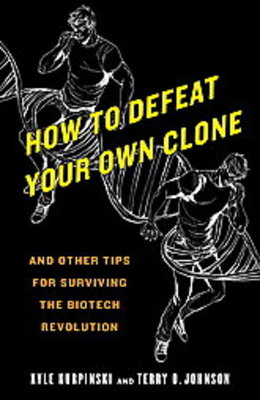
How to Defeat Your Own Clone and Other Tips for Surviving the Biotech Revolution
- Publisher: Bantam Dell Pub Group
- Publish date: 02/23/2010
Description:
ONE THE BIOTECH REVOLUTION (Engineering Life for Fun and Profit) In these days, a man who says a thing cannot be done is quite apt to be interrupted by some idiot doing it. --ELBERT GREEN HUBBARD Any sufficiently advanced technology is indistinguishable from magic. --ARTHUR C. CLARKE Let''s face it: cloning and genetic manipulations can be kinda scary. But why exactly? Is it because biotechnology is inherently dangerous, or is it because we don''t fully comprehend it? The history of our technological development can be viewed as a series of discoveries in tension with human culture. Few innovations are welcomed with unrestrained admiration, especially when they upset the established social order. Take for example the Luddites--a British social movement opposed to the innovations brought about by the Industrial Revolution-- who destroyed wool and cotton mills because these worked faster and cheaper than people did. Or consider how the splitting of the atom has changed the faces of warfare, diplomacy, and technology forever. It''s understandable that people are nervous about change, especially when said change involves unemployment or hiding under desks in the event of nuclear catastrophe. We do tend to forget that there are many innovations that once caused us great anxiety, but have come to be accepted as a part of modern life. In ancient Greece the airless space of a vacuum was a philosophical conundrum, mysteriously capable of extinguishing flames and causing small animals to die. Nowadays, it''s a convenient way to get crumbs out of the carpet. Not infrequently, the answer to an innovation''s dangers is more innovation. When human beings first started to congregate in large cities, disease grew to be such a problem that there was serious speculation that living in large cities was unnatural and unavoidably dangerous. People were not meant to live so close to one another. Cities were a disastrous and doomed experiment in living! Then plumbing happened. Today, critics assert that biotechnology is inherently dangerous. They argue that stem cell therapies will cause cancer, bioterrorism will be the downfall of the human race, and cloning is just a way of "playing God." All the while transhumanists (those who wish to improve humanity via technology) are telling us the exact opposite: stem cells are the key to unlimited healing and virtual immortality, bioengineered viruses will cure disease, and genetic engineering is just body modification on the molecular level. Those few scientists who make their opinions known outside of impenetrable academic journals tend toward cautious optimism, while the politicians who regulate these breakthroughs and the media who disseminate them into popular culture are currently in a contest to prove which can be more flagrantly ignorant. It''s a dead heat. In the long run, it doesn''t really matter what any of these groups say or believe. Progress is inevitable. Whether you love it, hate it, or simply do your best to ignore it, the biotech revolution has begun. We can''t tell you exactly what the future holds--only prophets or madmen truly know the future, and we authors are overqualified for one of those positions and underqualified for the other. So, we place our reputations in a certain amount of peril, making moderately educated guesses about the biology and medicine of tomorrow. We did this for two reasons: someone had to, and we needed the money. One final warning before we begin. This book will treat you like a machine. For those who find this dehumanizing, please keep in mind that we think you are an absolutely marvelous, unbelievably fascinating machine that we have devoted our professional lives to understanding. If you want to prepare yourself for genetic body upgrades and outrageous clone battles, it''s best to consider the engineering advantages of our point of view A BRIEF HISTORY OF BIOTECHNOLOGY Isaac Newton--one of history''s greatest scientists--is often quoted as having said, "If I have seen a little further, it is only by standing on the shoulders of giants." (Considering what Newton thought of some of his contemporaries, however, he might have been wearing cleats.) Before we clamber upon our betters for a peek at the future, let''s take a look at what has already come to pass. * Approximately 15,000 B.C.E.--Homo sapiens domesticate their first animal, Canis lupus familiaris, the subspecies of wolf we call dogs. Having acquired a best friend, the human race decides to see if there''s anything else in nature that could use a bit of tweaking. * Approximately 10,000 B.C.E.--The sowing and harvesting of plants begins in the Middle East. This quickly replaces the previous method of acquiring food from the earth, which is best described as "wander around a lot and avoid those little red berries." Farmers are soon selecting crops for specific characteristics such as yield, resistance to disease, and deliciousness. * Approximately 8,000 B.C.E.--The cow is domesticated and eventually becomes the Swiss Army knife of agriculture, driving plows and providing meat, milk, leather, and manure. * Approximately 4,000 B.C.E.--After several thousand odorous years of riding in carts behind cows, human beings domesticate the horse. Someday, we''ll pull our carts with giant, genetically engineered lobsters, but let''s take things one step at a time. * Approximately 400 B.C.E.--The ancient Greeks begin writing seriously about biology and medicine, setting down principles that will confuse and mislead scientists for centuries. * 1865--Gregor Mendel reads his paper "Experiments in Plant Hybridization" at two meetings of the Natural History Society of Brnn, Moravia. Initial response is underwhelming, but the scientific mainstream eventually recognizes him as "the Father of Modern Genetics," thanks to his groundbreaking work with pea plant heredity, shedding new light on how biological traits are passed to successive generations. Our understanding of pea biology quickly surpasses that of all other legumes. * 1902--Walter Sutton and Theodor Boveri independently propose that chromosomes may be the basis for Mendelian inheritance. Minds are blown. * 1909--Wilhelm Johannsen coins the word "gene" to describe Mendel''s fundamental unit of heredity. This single careless decision leads to a century of irritating puns comparing genetics to denim pants * 1928--Hans Spemann performs the first transfer of nuclear genetic material in amphibians, establishing the fundamental basis of laboratory cloning. * 1944--Oswald Avery demonstrates that DNA is the genetic material of the cell. * 1952--Robert Briggs and Thomas J. King perform the first successful animal cloning from early embryonic cells with northern leopard frogs. Unfortunately, this is just a specific species of frog, not a frog/leopard hybrid, but yes, that would be sweet. Give us a few years. * 1953--James Watson and Francis Crick publish their double- helix structure of DNA, with some underappreciated help from Rosalind Franklin''s experimental data (the lousy sexist fifties). * 1958--F. C. Steward grows a complete carrot plant from a single cell taken from the root of an adult plant, demonstrating that it''s possible to create a clone of at least one organism from an adult cell. Steward spends the rest of his career politely pretending that he''s never heard the "What''s up, Doc?" joke before. * 1963--J.B.S. Haldane coins the term "clone," without which we would have to call this book How to Defeat Your Own Genetically Identical Human. Thanks for the snappy title, J. * 1966--Marshall Nirenberg and Heinrich J. Matthaei decipher the genetic code, which turns out to be much better written than The Da Vinci Code. * 1972--Paul Berg creates the first recombinant DNA molecules, containing DNA sequences that are not normally found together. This technique becomes known as "gene splicing," and is fundamental to genetic manipulation and engineering. * 1972--Walter Fiers sequences the first gene, for a protein that forms part of the coating on a virus. The virus immediately begins questioning its own identity and selfdetermination. * 1973--Stanley Cohen and Herbert Boyer create the first recombinant DNA organism--transgenic E. coli bacteria that contain a DNA sequence from frogs. E. coli has since become the go-to organism for producing large amounts of relatively simple proteins, including pharmaceuticals such as insulin, human growth hormone, and erythropoietin. Not bad for a life- form previously known mostly for making you ill. * 1975--Frederick Sanger develops the Sanger method for DNA sequencing, a technique that allows scientists to "read" a section of DNA. * 1978--"Baby Louise" is the first child born through in vitro fertilization or IVF. Well into adulthood, she''s still known as Baby (a nickname appropriate in a very limited number of social situations). * 1983--Kary Mullis invents the polymerase chain reaction (PCR) protocol, which allows for rapid synthesis and copying of specific DNA sequences, allegedly with the creative assistance of a little LSD. * 1984--Steen Willadsen performs the first successful mammal cloning of sheep from embryonic cells, and this was twelve years before we ever heard about the whole "Dolly" thing. * 1990--The Human Genome Project is launched by the National Insti
Expand description
Product notice
Returnable at the third party seller's discretion and may come without consumable supplements like access codes, CD's, or workbooks.
| Seller | Condition | Comments | Price |
|
Evergreen Goodwill
|
Good

|
$2.65
|
|
HPB Inc.
|
Very Good
|
$3.93
|
|
SurplusTextSeller
|
Good |
$7.51
|
|
SKYLARKERBOOKS
|
Like New
|
$11.25
|
|
ErgodeBooks
|
Good |
$13.81
|
|
Bonita
|
Good
|
$32.01
|
|
Bonita
|
New
|
$64.75
|
|
Just one more Chapter
|
New |
$66.50
|
|
GridFreed
|
New |
$140.27
|

Please Wait