
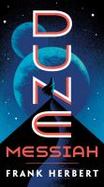
Dune Messiah
- List Price: $9.99
- Binding: Paperback
- Publisher: Penguin Random House
- Publish date: 06/04/2019
Description:
Table of Contents Title Page Copyright Page Introduction EPILOGUE Books by Frank Herbert THE BOOK OF FRANK HERBERT DESTINATION VOID (revised edition) DIRECT DESCENT THE DOSADI EXPERIMENT EYE THE EYES OF HEISENBERG THE GODMAKERS THE GREEN BRAIN THE MAKER OF DUNE THE SANTAROGA BARRIER SOUL CATCHER WHIPPING STAR THE WHITE PLAGUE THE WORLDS OF FRANK HERBERT MAN OF TWO WORLDS (with Brian Herbert) The Dune Chronicles DUNE DUNE MESSIAH CHILDREN OF DUNE GOD EMPEROR OF DUNE HERETICS OF DUNE CHAPTERHOUSE: DUNE Books by Frank Herbert and Bill Ransom THE JESUS INCIDENT THE LAZARUS EFFECT THE ASCENSION FACTOR Books edited by Brian Herbert THE NOTEBOOKS OF FRANK HERBERT''S DUNE SONGS OF MUAD''DIB THE BERKLEY PUBLISHING GROUP Published by the Penguin Group Penguin Group (USA) Inc. 375 Hudson Street, New York, New York 10014, USA Penguin Group (Canada), 90 Eglinton Avenue East, Suite 700, Toronto, Ontario M4P 2Y3, Canada (a division of Pearson Penguin Canada Inc.) Penguin Books Ltd., 80 Strand, London WC2R 0RL, England Penguin Group Ireland, 25 St. Stephen''s Green, Dublin 2, Ireland (a division of Penguin Books Ltd.) Penguin Group (Australia), 250 Camberwell Road, Camberwell, Victoria 3124, Australia (a division of Pearson Australia Group Pty. Ltd.) Penguin Books India Pvt. Ltd., 11 Community Centre, Panchsheel Park, New Delhi--110 017, India Penguin Group (NZ), 67 Apollo Drive, Rosedale, North Shore 0632, New Zealand (a division of Pearson New Zealand Ltd.) Penguin Books (South Africa) (Pty.) Ltd., 24 Sturdee Avenue, Rosebank, Johannesburg 2196, South Africa Penguin Books Ltd., Registered Offices: 80 Strand, London WC2R 0RL, England This is a work of fiction. Names, characters, places, and incidents either are the product of the author''s imagination or are used fictitiously, and any resemblance to actual persons, living or dead, business establishments, events, or locales is entirely coincidental. The publisher does not have any control over and does not assume any responsibility for author or third-party websites or their content. Published by arrangement with Herbert Properties LLC. Copyright 1969 by Frank Herbert. All rights reserved. No part of this book may be reproduced, scanned, or distributed in any printed or electronic form with out permission. Please do not participate in or encourage piracy of copyrighted materials in violation of the author''s rights. Purchase only authorized editions. ACE and the "A" design are trademarks belonging to Penguin Group (USA) Inc. Library of Congress Cataloging-in-Publication Data Herbert, Frank. Dune messiah / Frank Herbert ; with a new introduction by Brian Herbert. p. cm.--(Dune chronicles ; bk. 2) eISBN : 978-1-101-15787-9 1. Dune (Imaginary place)--Fiction. I. Title. PS3558.E63D86 2008 813''.54--dc22 2007040248 INTRODUCTION by Brian Herbert D une Messiah is the most misunderstood of Frank Herbert''s novels. The reasons for this are as fascinating and complex as the renowned author himself. Just before this first sequel to Dune was published in 1969, it ran in installments in the science fiction magazine Galaxy . The serialized "Dune Messiah" was named "disappointment of the year" by the satirical magazine National Lampoon . The story had earlier been rejected by Analog editor John W. Campbell, who, like the Lampooners, loved the majestic, heroic aspects of Dune and hated the antithetical elements of the sequel. His readers wanted stories about heroes accomplishing great feats, he said, not stories of protagonists with "clay feet." The detractors did not understand that Dune Messiah was a bridging work, connecting Dune with an as-yet-uncompleted third book in the trilogy. To get there, the second novel in the series flipped over the carefully crafted hero myth of Paul Muad''Dib and revealed the dark side of the messiah phenomenon that had appeared to be so glorious in Dune . Many readers didn''t want that dose of reality; they couldn''t stand the demotion of their beloved, charismatic champion, especially after the author had already killed off two of their favorite characters in Dune , the loyal Atreides swordmaster Duncan Idaho1 and the idealistic planetologist Liet-Kynes. But they overlooked important clues that Frank Herbert had left along the way. In Dune , when Liet-Kynes lay dying in the desert, he remembered these words of his father, Pardot, spoken years before and relegated to the back reaches of memory: "No more terrible disaster could befall your people than for them to fall into the hands of a Hero." Near the end of the novel, in a foreshadowing epigraph, Princess Irulan described the victorious Muad''Dib in multifaceted and sometimes conflicting terms as "warrior and mystic, ogre and saint, the fox and the innocent, chivalrous, ruthless, less than a god, more than a man." And in an appendix to Dune , Frank Herbert wrote that the desert planet "was afflicted by a Hero." These sprinklings in Dune were markers pointing in the direction Frank Herbert had in mind, transforming a utopian civilization into a violent dystopia. In fact, the original working title for the second book in the series was Fool Saint , which he would change two more times before settling on Dune Messiah . But in the published novel, he wrote, concerning Muad''Dib: He is the fool saint, The golden stranger living forever On the edge of reason. Let your guard fall and he is there! The author felt that heroic leaders often made mistakes . . . mistakes that were amplified by the number of followers who were held in thrall by charisma. As a political speechwriter in the 1950s, Dad had worked in Washington, D.C., and had seen the megalomania of leadership and the pitfalls of following magnetic, charming politicians. Planting yet another interesting seed in Dune , he wrote, "It is said in the desert that possession of water in great amount can inflict a man with fatal carelessness." This was an important reference to Greek hubris. Very few readers realized that the story of Paul Atreides was not only a Greek tragedy on an individual and familial scale. There was yet another layer, even larger, in which Frank Herbert was warning that entire societies could be led to ruination by heroes. In Dune and Dune Messiah , he was cautioning against pride and overconfidence, that form of narcissism described in Greek tragedies that invariably led to the great fall. Among the dangerous leaders of human history, my father sometimes mentioned General George S. Patton because of his charismatic qualities--but more often his example was President John F. Kennedy. Around Kennedy, a myth of kingship had formed, and of Camelot. The handsome young president''s followers did not question him and would have gone virtually anywhere he led them. This danger seems obvious to us now in the cases of such men as Adolf Hitler, whose powerful magnetism led his nation into ruination. It is less obvious, however, with men who are not deranged or evil in and of themselves--such as Kennedy, or the fictional Paul Muad''Dib, whose danger lay in the religious myth structure around him and what people did in his name. Among my father''s most important messages were that governments lie to protect themselves and they make incredibly stupid decisions. Years after the publication of Dune , Richard M. Nixon provided ample proof. Dad said that Nixon did the American people an immense favor in his attempt to cover up the Watergate misdeeds. By amplified example, albeit unwittingly, the thirty-seventh president of the United States taught people to question their leaders. In interviews and impassioned speeches on university campuses all across the country, Frank Herbert warned young people not to trust government, telling them that the American founding fathers had understood this and had attempted to establish safeguards in the Constitution. In the transition from Dune to Dune Messiah , Dad accomplished something of a sleight of hand. In the sequel, while emphasizing the actions of the heroic Paul Muad''Dib, as he had done in Dune , the author was also orchestrating monumental background changes and dangers involving the machinations of the people surrounding that leader. Several people would vie for position to become closest to Paul; in the process they would secure for themselves as much power as possible, and some would misuse it, with dire consequences. After the Dune series became wildly popular, many fans began to consider Frank Herbert in a light that he had not sought and which he did not appreciate. In one description of him, he was referred to as "a guru of science fiction." Others depicted him in heroic terms. To counter this, in remarks that were consistent with his Paul Atreides characterization, Frank Herbert told interviewers that he did not want to be considered a hero,
Expand description
Product notice
Returnable at the third party seller's discretion and may come without consumable supplements like access codes, CD's, or workbooks.
| Seller | Condition | Comments | Price |
|
Greenworld Books
|
Very Good |
$1.11
|
|
Goodwill of Greater Milwaukee
|
Good |
$1.52
|
|
Goodwill of Greater Milwaukee
|
Good |
$1.63
|
|
Goodwill Books
|
Good

|
$1.98
|
|
ClickGoodwill
|
Good
|
$2.53
|
|
Red's Corner
|
Like New
|
$3.37
|
|
Good Books Will Follow
|
Good
|
$3.73
|
|
HPB-Diamond
|
Very Good
|
$4.03
|
|
HPB-Ruby
|
Very Good
|
$4.48
|
|
HPB-Emerald
|
Very Good
|
$4.48
|
|
HPB Inc.
|
Very Good
|
$4.48
|
|
Half Price Books Inc
|
Very Good
|
$4.48
|
|
EdmondDantes Bookseller
|
Very Good
|
$5.60
|
|
HPB-Ruby
|
Very Good
|
$5.61
|
|
HPB-Emerald
|
Very Good
|
$5.61
|
|
HPB-Diamond
|
Very Good
|
$5.61
|

Please Wait