
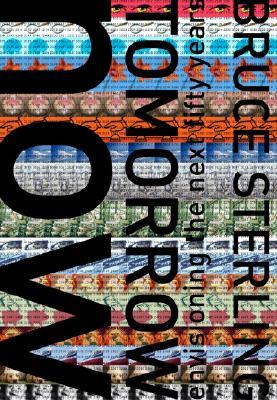
Tomorrow Now: Envisioning the Next Fifty Years
- Binding: Hardcover
- Publisher: Random House
- Publish date: 12/01/2002
Description:
Stage 1 The Infant And one man in his time plays many parts, His acts being seven ages. At first the infant, Mewling and puking in the nurse''s arms. The infant personifies the future. You place your children into history. You are their past. Futurists like to study population growth and trends in demographics, which is to say, people having children. The infant is no mathematical abstraction, though; a baby is the future howling aloud. Tomorrow now, born naked. The delivery room is a place of primal hope and fear. It''s a dramatic arena of suffering and risk. Few things are as common as a human child born all right, but when the futurist''s own child is the hostage to fortune, there are very few comforts found in statistics. What if the baby dies? What if the mother dies? What if the baby is born deformed, with decades of sorrow ahead? The clock ticks, a child comes into the world, and no amount of rational analysis will stop that process. People must live with the consequences--because people are the consequences. I like to think that as a father-to-be I fully deserved my many anxieties. Childbirth was certainly the most profound encounter with the future I have ever had. But unlike millions of jittery fathers in the past, I had a benefit in my possession that lacked historical precedent. I had a pocket photo of my child, taken before she was born. I had a sonogram. It was a printout from a medical scanner. Its sonar nozzle had slid all over my wife''s distended midriff, greased with clean medical jelly. The doctor had to wiggle this device about a bit, and peer and head-scratch through its Delphic, futuristic blurring, but he did it in real time and right in front of us. The child''s limbs were in order, the growth numbers looked right, and to judge by the sonar shadows of her little pelvis, she was a girl. What comfort we took from that technological artifact. With a sonogram at hand, you can abandon half the book of baby names. You can spin new plans for the colors of the curtains and the bassinet. This sonogram was like prenatal radar, full of swimming promise. Primeval darkness had left the womb. Its silent inhabitant was no longer a "pregnancy." "It" became "her." That is how I first glimpsed my daughter: through an instrument. But my daughter did not, in fact, begin as an infant, or even as a sonogram. She began, just like her dear mom and dad, just like you, as an anonymous entity the size of a pencil dot. Humanity''s origin is in the realm of the microscopic. That is the true start of our story. Human eggs are minuscule, but we moderns can see them. They''re no longer metaphysical, they''re not folk legend or fertility ritual. They have become the province of rapidly advancing biotechnology. Single cells can be measured and manipulated, extracted and preserved. What we can see, we can sort, shape, and sell. We penetrated the realm of the microscopic with ever-growing technical sophistication. In the twentieth century we came to realize, with growing excitement, that the general business of life on Earth all runs on the same hardware. It''s all cells, and at the centers of cells, it''s always DNA. The business of life is Life-on-Earth Incorporated and Unlimited, a wholly owned subsidiary of deoxyribonucleic acid. Genetic engineering is the twenty-first century''s own new baby. In the century''s dawn, biotech is its star turn. Biotech is by no means tomorrow''s only major technology. The twenty-first century has the whole technological family crammed under its roof, fork in hand at the trestle table, a vast clan of hungry transformations, many of them centuries old: printing, clocks, railroads, electric power, radio, television, air flight, nuclear fission, satellites, and computation; it has the works. It''s an orgy of sibling rivalry. But genetic engineering is tomorrow''s native-born contribution to that family. It''s the newest, the riskiest, and if it survives and flourishes, it will become the most powerful. Biotech is a baby Hercules that wants to kick the slats out of the crib. Babies don''t stay babies. My first daughter, for instance, is for the moment a thriving teen. Her rocketing passage toward maturity is written all over her; every day sees her blatantly learning and growing. Biotech is the baby industry now, but when it''s big, it will reshape reality. To describe a biotech world, a world with a mature genetic technology, requires a new language. A new vocabulary, a new set of assumptions, a new literacy. A baby, once she gets going, does not stop. It''s a very different world, the future, but we''re never going to "get there." There''s no place "there" for us to get. The future is a process, not a theme park. The future itself has a future. We, in this present moment, are part of the future''s past. The future is not an alien world, it is this very world, with different people, at a different time. Yesterday, today, or tomorrow, the clock never stops ticking. Every new stage must grow on the mulch of the last. Bearing that in mind, let me introduce you into a biotech world. Here you are, let us say, reading a book. Not this book (unless you''re some kind of antiquarian) but a similar one. Are there books in your biotech world? Yes. Made of paper? Sort of. Is that ink? Not ink as ink was previously understood, no; but why would you bother to notice that? Let me make a few impolite personal observations as you sit there reading. By twentieth-century standards, you don''t look very clean. In fact, you look rather greasy, and you''re somewhat odd-smelling. But you are impressively robust and glittery-eyed, and full of animal vitality. Even though you are a harmless reader of late-twenty-first-century pop-science books, praiseworthily engaged in the intellectual trends of your own decade, you don''t look especially scholarly. On the contrary: basically, you look like an athlete or supermodel. You look that way not because you''re all egotistically eager to stand out from the norm but because that is your norm. An athlete or a supermodel is what men and women are willing to pay to look like. In your epoch, flesh and the processes of its construction are very ductile. You have no tooth decay, no dandruff, no enlarged pores. Though you read too much, you have no glasses. Your home is snug and elegant. Its walls, floors, and furnishings are made of warm, organic substances that resemble cork, bamboo, and redwood, although they aren''t. The lawn outside your membrane window has eight or nine hundred species living in it. It is a biodiverse menagerie. You''re just a normal person in a biotech world. You are not some grand chrome-dome master of biotech--no single mind can ever master such a broad field. Biotech is not even your personal line of work; you just live there. Your lawn is aswarm with living things because of social pressure from your neighbors. A mowed lawn is a scandal; you wouldn''t subject the neighborhood to such a sight any more than you''d shave your children''s heads to eradicate lice. You don''t go out there and garden it, either. The lawn tools know more about plants than you do. And they work by themselves. It''s a city lawn, not a wilderness. It''s autogardening. The "wild" animals living in it don''t know they are under surveillance. Out on the street are scarab-colored nonpolluting vehicles that run on hydrogen. Like most industrial objects, they rot on command and return to harmless compost. Then there''s your plumbing, or, as people put it nowadays, your "waterworks." In a biotech world, water networks are a bigger deal than bit streams. You''re not made out of digital bits--like all living things, you are made mostly of water. So that''s where you sensibly place your high-tech investments. You don''t have a "shower stall." You have a standard, everyday body-imaging system that gives you complete interior and exterior health scans every morning as it washes you. Your toothbrush scans the contents of your mouth and catalogs its microorganisms. Your toilet is the most sophisticated network peripheral in the home. It provides you with vital metabolic information about your body--the substances that enter and leave it and the vital processes within it. Only fools are squeamish about this. Your bathroom cabinet is full of unguents, greases, and perfumes. There are some pills in there, but most of them do not contain drugs. Instead, they contain living, domesticated organisms that make drugs while living inside you. Some of the "pills" are cameras, with tiny sensors and onboard processing. Nothing in your medicine cabinet is sterile, not even the bandages. Modern bandages contain living organisms that are good for wounds. "Sterility" is what people do need when they don''t know what''s happening on a microbial level. In a biotech world, sterility is a confession of ignorance. It''s a tactic of desperation. In your kitchen, the mops have more processing power than twentieth-century national bureaucracies. Your kitchen is mostly a place of filters and membranes and films; it is certainly not a butcher shop or a place to process raw vegetable matter. You eat delicate and tasty knickknacks that differ radically from grotesque historical foodstuffs. You have no fridge, because nothing in your house ever rots without your permission. Even though this is a genetically altered world, there are no weird-looking "mutants" or "monsters" in your house, neighborhood, or city. You don''t have, for instance, a six-legged dog. The cop on the beat is not ten feet high, and she does not look like RoboCop; if she has a baton, it doubles as a swab. It''s not that such
Expand description
Product notice
Returnable at the third party seller's discretion and may come without consumable supplements like access codes, CD's, or workbooks.
| Seller | Condition | Comments | Price |
|
Greenworld Books
|
Good |
$1.11
|
|
Garys Books-Log Cabin Books
|
Like New |
$5.62
|
|
HPB Inc.
|
Very Good

|
$6.28
|
|
HPB-Diamond
|
Very Good
|
$8.98
|
|
Maxwell's House of Books
|
Very Good
|
$9.00
|
|
ErgodeBooks
|
Good |
$13.43
|
|
Kubik Fine Books Ltd
|
Like New
|
$16.87
|
|
Southampton Sag Harbor Books
|
Like New
|
$22.50
|
|
Bonita
|
Good
|
$32.10
|
|
ErgodeBooks
|
New |
$33.46
|
|
Bonita
|
New
|
$63.06
|
|
Just one more Chapter
|
New |
$64.30
|
|
GridFreed
|
New |
$87.95
|

Please Wait