
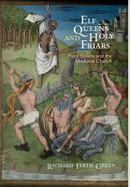
Elf Queens and Holy Friars : Fairy Beliefs and the Medieval Church
- List Price: $69.95
- Binding: Hardcover
- Publisher: University of Pennsylvania Press
- Publish date: 08/19/2016
Description:
IntroductionFor many pious Christians, as for the inquisitors of Joan of Arc, this was a distinction without a difference. Fairies were demons, plain and simple.--Carl Sagan, The Demon-Haunted World On Trinity Sunday sometime around the year 1400 a sermon was preached in England containing an extended denunciation of popular superstition. Palmists, dream readers, pythoners, nigromancers, astrologers, and the makers of wax effigies were all quickly dismissed, and then the preacher turned to those who believed in fairies:There are also others who say that they see women and girls dancing by night whom they call elvish folk and they believe that these can transform both men and women or, leaving others in their place, carry them with them to elfland ; all of these are mere fantasies bequeathed to them by an evil spirit. For when the devil has won over the soul of such a person to believing such things, he transforms himself otherwise, now into the form of an angel, now a man, now a woman, now other creatures, now in dances and other games, and thus by the weak faith of their souls such wretches are deceived. But those who believe in the aforesaid things, or stubbornly defend them, or propagate them, especially when they shall have learned the truth, are faithless and worse than pagans, and four times a year they are cursed by the Lord and his holy church. . . . They should know that they have forsaken the faith of Christ, betrayed their baptism, and incurred the anger and enmity of God.This attack is not entirely original, for it draws heavily on an early fourteenth-century preachers'' manual, the Fasciculus Morum (which had also included tournaments and jousts in its list of fairy activities), but it will serve as a useful introduction to the subject of this book: fairyland as a contested site in the struggle between the official and unofficial cultures of the Middle Ages. As this quotation implies, the default position of the clerical elite when it came to fairyland was one of unrelieved antagonism (though in practice, as we shall see, not all churchmen were as implacably hostile as our preacher), and the official record is the story of an ever-increasing demonization of fairies and infernalization of fairyland throughout the course of the Middle Ages. Vernacular culture on the other hand might make remarkable efforts to adjust its beliefs to the orthodoxies of the church, either consciously engaging in what Carlo Ginzburg has termed "cultural compromise formation" or unconsciously echoing what Antonio Gramsci would have regarded as the church''s dominant hegemonic discourse. Thus we should not be surprised to encounter fairies who swear by the Virgin Mary, who are eager to attend mass, or who anticipate salvation on Doomsday. The history of this aspect of medieval popular culture and its systematic suppression is accordingly far from straightforward, and it is made all the more difficult by the nature of the evidence, which overwhelmingly reflects the views of the clerical elite. An analysis of the kinds of evidence available to us and suggestions for ways we might read them will occupy the first two chapters of this study. Fundamental to my approach is the assumption that the beliefs of those for whom fairies were a living presence were sincerely held and that we should do them the courtesy of taking their beliefs seriously. I will argue that this makes a great difference to the way we approach the medieval literary genre that has most to tell us about fairies--that of the popular romance. The last three chapters will offer readings of various aspects of fairy belief, but from the outset it is important that I establish what the reader should not expect to find there. First, I will have nothing to say on the vexed question of fairy taxonomy. Are fairies different from elves? or goblins? or dwarves? or pucks? or brownies? and how do they relate to French netons or luitons ? or German Nixen or Kobolde ? Moreover, are they of human stature or smaller? Are they ruled by a king, or a queen, or even a trio of queens? And what color are they? In my view all such questions are unanswerable, and any attempt at a totalizing definition will prove illusory. For instance, while some fairies were small (such as the pygmies in Walter Map''s story of King Herla), others must have been human sized or they could hardly have had love affairs with mortals. It is not a matter on which we can properly legislate. Simon Young has shown convincingly how little agreement there is about the meanings of terms for fairies collected by folklorists in nineteenth-century Cornwall, concluding that "there is enormous blurring in lore and very often taxonomic categories misrepresented the beliefs of a given area"; if this is true of a single well-documented English county in a recent century, what hope can there be of our reconstructing a coherent fairy taxonomy for the whole of the European Middle Ages with the far scantier evidence that is available to us? As Young writes, "anyone who studies history has to constantly remind themselves that those people living hundreds of years ago did not structure their experience as we do." Even in the Middle Ages fairy taxonomy seems to have been problematic. Thomas of Cantimpr, for instance, tries to categorize fairies in the final section of his midthirteenth-century book of moral instruction, De bonum universale de apibus [On the Universal Good of Bees] but the enterprise quickly falls apart. Turning from his admirable bees, he sets out, under the headings of ''wasps,'' ''cockroaches,'' ''hornets,'' and ''beetles'' [ vespae, blattae, crabrones , and buprestes ], to describe the depredations of various kinds of demon. Wasp demons, he says, cause tempests, and cockroach demons cause bad dreams, but when he turns to what we might call ''fairies'' (under the heading of ''hornets''), we discover that these too can cause tempests and bad dreams. Hornet demons, he says, can be divided into four classes: neptuni , who swim in water; incubi , who roam the earth; dusii , who live under the earth; and spiritualia nequitie in celestibus , who inhabit the air. This is already an eccentric classification since for Saint Augustine (as for most of the medieval commentators who followed him), incubi and dusii were clearly one and the same thing. Moreover, none of these terms is likely to have been used at the level of popular speech, nor is his classification likely to have represented any kind of popular taxonomy. Neptuni is evidently a commonization from the Roman god, and it is just possible that some such term was in popular usage, if only as a folk etymology for the French neton . On the other hand, there does not seem to have been anything particularly aquatic about netons , and whatever wassergeister Thomas of Cantimpr may have had in mind were probably called something quite different in common speech. The word dusius may well be the Latin form of a Gaulish word current in Augustine''s day, but it seems to have died out in European vernaculars by the thirteenth century. Incubus , probably the most widely used general scholastic term for ''fairy'' in the Middle Ages, derives etymologically from the sense of being weighed down ( incubitus ) or smothered in sleep. The closest equivalent in English for this specialized sense would have been ''nightmare'' (in French cauchemar and in German nachtmahr ), but incubus underwent semantic generalization early--though not, as Thomas of Cantimpr would have it, to ''earthbound spirit'' but rather (as we shall see in Chapter 3) to ''fairy lover.'' Finally, when he comes to ''the wicked spirits of the air'' (evidently Thomas has no specific name for them and must resort to Ephesians 6:12), he starts out by describing demonic tempests (not obviously different from those caused by the vespae ) and then falls back on the general category of illusions (which turn out to include blattae -like dreams and incubi -like seductions!). After all this we should not be surprised to find that Thomas seems to have completely forgotten about the beetles ( buprestes ) with which he started out. In the end he simply gives up and launches into a recital of miscellaneous marvels, some of which he claims to have experienced personally. At least the taxonomy supplied by John Walsh, a Devonshire cunning man, in 1566 has the virtue of simplicity: "[he] saith that ther be .iii. kindes of Feries, white, greene, and blacke . . . Wherof (he sayth) the blacke Feries be the woorst." Incidentally, the question of fairy coloring is its own mare''s nest. In addition to white, black, and green (green is sometimes mentioned--as with the green children of Woolpit--but it is by no means universal), we also have gray (in The Merry Wives of Windsor ), red (in an account from Thomas Walsingham), and polychrome (as with Tristram''s fairy dog Petitcriu). Perhaps the key to all this is the innate volatility of fairies: they can be any size (or shape) they wish, and, as in Petitcriu''s case, their color is inherently unstable. No attempt, whether medieval or modern, to impose a logical order on spontaneous local traditions can ever be totally satisfactory (though those who still feel themselves in need of such answers can always turn for help to Katharine Briggs or Claude Lecouteux). My own solution to this problem, however, is functional: for the purposes of this study I am concerned primarily with that class of numinous, social, humanoid creatures who were widely believed to live at the fringes of the human lifeworld and interact intermittently with human beings. In this they differed from those solitary creatures who inhabited the wilderness (gia
Expand description
Product notice
Returnable at the third party seller's discretion and may come without consumable supplements like access codes, CD's, or workbooks.
| Seller | Condition | Comments | Price |
|
Midtown Scholar Bookstore
|
Good |
$28.73
|

Please Wait