
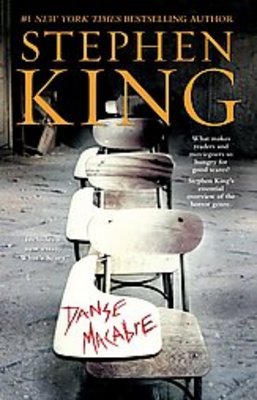
Danse Macabre
- List Price: $21.00
- Publisher: Pocket Books
- Publish date: 01/26/2010
Description:
Chapter I: October 4, 1957, and an Invitation to Dance CHAPTER I October 4, 1957, and an Invitation to Dance For me, the terror--the real terror, as opposed to whatever demons and boogeys which might have been living in my own mind--began on an afternoon in October of 1957. I had just turned ten. And, as was only fitting, I was in a movie theater: the Stratford Theater in downtown Stratford, Connecticut. The movie that day was and is one of my all-time favorites, and the fact that it--rather than a Randolph Scott western or a John Wayne war movie--was playing was also only fitting. The Saturday matinee on that day when the real terror began was Earth vs. the Flying Saucers , starring Hugh Marlowe, who at the time was perhaps best known for his role as Patricia Neal''s jilted and rabidly xenophobic boyfriend in The Day the Earth Stood Still --a slightly older and altogether more rational science fiction movie. In The Day the Earth Stood Still, an alien named Klaatu (Michael Rennie in a bright white intergalactic leisure suit) lands on The Mall in Washington, D.C., in a flying saucer (which, when under power, glows like one of those plastic Jesuses they used to give out at Vacation Bible School for memorizing Bible verses). Klaatu strides down the gangway and pauses there at the foot, the focus of every horrified eye and the muzzles of several hundred Army guns. It is a moment of memorable tension, a moment that is sweet in retrospect--the sort of moment that makes people like me simple movie fans for life. Klaatu begins fooling with some sort of gadget--it looked kind of like a Weed-Eater, as I recall--and a trigger-happy soldier-boy promptly shoots him in the arm. It turns out, of course, that the gadget was a gift for the President. No death ray here; just a simple interstellar cure for cancer. That was in 1951. On that Saturday afternoon in Connecticut some six years later, the folks in the flying saucers looked and acted a good deal less friendly. Far from the noble and rather sad good looks of Michael Rennie as Klaatu, the space people in Earth vs. the Flying Saucers looked like old and extremely evil living trees, with their gnarled, shriveled bodies and their snarling old men''s faces. Rather than bringing a cure for cancer to the President like any new ambassador bringing a token of his country''s esteem, the saucer people in Earth vs. the Flying Saucers bring death rays, destruction, and, ultimately, all-out war. All of this--most particularly the destruction of Washington, D.C.--was rendered with marvelous reality by the special effects work of Ray Harryhausen, a fellow who used to go to the movies with a chum named Ray Bradbury when he was a kid. Klaatu comes to extend the hand of friendship and brotherhood. He offers the people of Earth membership in a kind of interstellar United Nations--always provided we can put our unfortunate habit of killing each other by the millions behind us. The saucerians of Earth vs. the Flying Saucers come only to conquer, the last armada of a dying planet, old and greedy, seeking not peace but plunder. The Day the Earth Stood Still is one of a select handful--the real science fiction movies. The ancient saucerians of Earth vs. the Flying Saucers are emissaries of a much more common breed of film--the horror-show. No nonsense about "It was to be a gift for your President" here; these folks simply descend upon Hugh Marlowe''s Operation Skyhook at Cape Canaveral and begin kicking ass. It is in the space between these two philosophies that the terror was seeded, I think. If there is a line of force between such neatly opposing ideas, then the terror almost certainly grew there. Because, just as the saucers were mounting their attack on Our Nation''s Capital in the movie''s final reel, everything just stopped. The screen went black. The theater was full of kids, but there was remarkably little disturbance. If you think back to the Saturday matinees of your misspent youth, you may recall that a bunch of kids at the movies has any number of ways of expressing its pique at the interruption of the film or its overdue commencement--rhythmic clapping; that great childhood tribal chant of "We-want-the- show! We-want-the- show! We-want-the- show!"; candy boxes that fly at the screen; popcorn boxes that become bugles. If some kid has had a Black Cat firecracker in his pocket since the last Fourth of July, he will take this opportunity to remove it, pass it around to his friends for their approval and admiration, and then light it and toss it over the balcony. None of these things happened on that October day. The film hadn''t broken; the projector had simply been turned off. And then the house-lights began to come up, a totally unheard-of occurrence. We sat there looking around, blinking in the light like moles. The manager walked into the middle of the stage and held his hands up--quite unnecessarily--for quiet. Six years later, in 1963, I flashed on that moment when, one Friday afternoon in November, the guy who drove us home from school told us that the President had been shot in Dallas. 2 If there is any truth or worth to the danse macabre, it is simply that novels, movies, TV and radio programs--even the comic books--dealing with horror always do their work on two levels. On top is the "gross-out" level--when Regan vomits in the priest''s face or masturbates with a crucifix in The Exorcist, or when the raw-looking, terribly inside-out monster in John Frankenheimer''s Prophecy crunches off the helicopter pilot''s head like a Tootsie-Pop. The gross-out can be done with varying degrees of artistic finesse, but it''s always there. But on another, more potent level, the work of horror really is a dance--a moving, rhythmic search. And what it''s looking for is the place where you, the viewer or the reader, live at your most primitive level. The work of horror is not interested in the civilized furniture of our lives. Such a work dances through these rooms which we have fitted out one piece at a time, each piece expressing--we hope!--our socially acceptable and pleasantly enlightened character. It is in search of another place, a room which may sometimes resemble the secret den of a Victorian gentleman, sometimes the torture chamber of the Spanish Inquisition... but perhaps most frequently and most successfully, the simple and brutally plain hole of a Stone Age cave-dweller. Is horror art? On this second level, the work of horror can be nothing else; it achieves the level of art simply because it is looking for something beyond art, something that predates art: it is looking for what I would call phobic pressure points. The good horror tale will dance its way to the center of your life and find the secret door to the room you believed no one but you knew of--as both Albert Camus and Billy Joel have pointed out. The Stranger makes us nervous... but we love to try on his face in secret. Do spiders give you the horrors? Fine. We''ll have spiders, as in Tarantula, The Incredible Shrinking Man, and Kingdom of the Spiders . What about rats? In James Herbert''s novel of the same name, you can feel them crawl all over you... and eat you alive. How about snakes? That shut-in feeling? Heights? Or... whatever there is. Because books and movies are mass media, the field of horror has often been able to do better than even these personal fears over the last thirty years. During that period (and to a lesser degree, in the seventy or so years preceding), the horror genre has often been able to find national phobic pressure points, and those books and films which have been the most successful almost always seem to play upon and express fears which exist across a wide spectrum of people. Such fears, which are often political, economic, and psychological rather than supernatural, give the best work of horror a pleasing allegorical feel--and it''s the one sort of allegory that most filmmakers seem at home with. Maybe because they know that if the shit starts getting too thick, they can always bring the monster shambling out of the darkness again. We''re going back to Stratford in 1957 before much longer, but before we do, let me suggest that one of the films of the last thirty years to find a pressure point with great accuracy was Don Siegel''s Invasion of the Body Snatchers . Further along, we''ll discuss the novel--and Jack Finney, the author, will also have a few things to say--but for now, let''s look briefly at the film. There is nothing really physically horrible in the Siegel version of Invasion of the Body Snatchers; I no gnarled and evil star travelers here, no twisted, mutated shape under the facade of normality. The pod people are just a little different, that''s all. A little vague. A little messy. Although Finney never puts this fine a point on it in his book, he certainly suggests that the most horrible thing about "them" is that they lack even the most common and easily attainable sense of aesthetics. Never mind, Finney suggests, that these usurping aliens from outer space can''t appreciate La Traviata or Moby Dick or even a good Norman Rockwell cover on the Saturday Evening Post . That''s bad enough, but--my God!--they don''t mow their lawns or replace the pane of garage glass that got broken when the kid down the street batted a baseball through it. They don''t repaint their houses when they get flaky. The roads leading into Santa Mira, we''re told, are so full of potholes and washouts that pretty soon the salesmen who service the town--who aerate it
Expand description
Product notice
Returnable at the third party seller's discretion and may come without consumable supplements like access codes, CD's, or workbooks.
| Seller | Condition | Comments | Price |
|
Dream Books Co.
|
Good

|
$10.38
|
|
Greenworld Books
|
Good |
$10.51
|
|
Zoom Books East
|
Good |
$10.52
|
|
HPB-Ruby
|
Very Good
|
$11.63
|
|
HPB-Emerald
|
Very Good
|
$11.70
|
|
Ink Drinkers Bookshop
|
Very Good
|
$12.08
|

Please Wait