
Due to planned maintenance, your school has disabled school system log-ins at this time.
You may continue shopping as a guest, or by creating a bookstore-only account.
Please complete the purchase of any items in your cart before going to this third-party site.
Also note that if you qualify for financial aid, items purchased through this site will not be subject to
reimbursement.
1st Printing. 12mo-over 6¾-7¾" tall. pp. 179. Ex-library with the usual
[...]
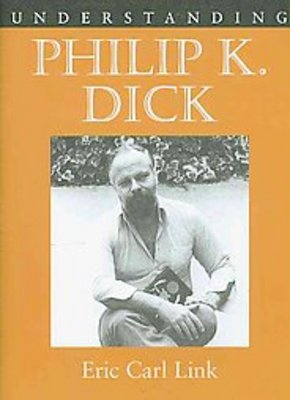
1st Printing. 12mo-over 6¾-7¾" tall. pp. 179. Ex-library with the usual library markings (if not for the library markings this copy would be graded in fine condition); overall a nice used copy! Black boards with silver lettering on the spine. 179 historical and informative pages! "Author of more than forty novels and myriad short stories over a three-decade literary career, Philip K. Dick (1928-1982) single-handedly reshaped twentieth-century science fiction. His influence has only increased since his death with the release of numerous feature films based on his work, including Blade Runner (based on Do Androids Dream of Electric Sheep? ), Total Recall (based on "We Can Remember It for You Wholesale"), Minority Report (based on "The Minority Report"), and Next (based on "The Golden Man"). In Understanding Philip K. Dick, Eric Carl Link introduces readers to the life, career, and work of this groundbreaking, prolific, and immeasurably influential force in American literature, media culture, and contemporary science fiction. Dick was at times a postmodernist, a mainstream writer, a pulp fiction writer, and often all three simultaneously, but as Link illustrates, he was more than anything else a novelist of ideas. From this vantage point, Link surveys Dick's own tragicomic biography, his craft and career, and the recurrent ideas and themes that give shape and significance to his fiction. Link addresses Dick's efforts to break into the mainstream in the 1950s, his return to science fiction in the 1960s, and his move toward more theologically oriented work in his final two decades. Link finds across Dick's writing career an intellectual curiosity that transformed his science fiction novels from bizarre pulp extravaganzas into philosophically challenging explorations of the very nature of reality, and it is this depth of vision that continues to garner new audiences and fresh approaches to Dick's genre-defining tales...."
You are licensing a digital product for a set duration.
Durations are set forth in the product description, with "Lifetime" typically meaning five (5) years of online access and permanent download to a supported device.
All licenses are non-transferrable.
More details can be found here. May come without consumable supplements like access codes, CD's, or workbooks.
Product notice
Returnable at the third party seller's discretion and may come without consumable supplements like access codes, CD's, or workbooks.
1st Printing. 12mo-over 6¾-7¾" tall. pp. 179. Ex-library with the usual
[...]
1st Printing. 12mo-over 6¾-7¾" tall. pp. 179. Ex-library with the usual library markings (if not for the library markings this copy would be graded in fine condition); overall a nice used copy! Black boards with silver lettering on the spine. 179 historical and informative pages! "Author of more than forty novels and myriad short stories over a three-decade literary career, Philip K. Dick (1928-1982) single-handedly reshaped twentieth-century science fiction. His influence has only increased since his death with the release of numerous feature films based on his work, including Blade Runner (based on Do Androids Dream of Electric Sheep? ), Total Recall (based on "We Can Remember It for You Wholesale"), Minority Report (based on "The Minority Report"), and Next (based on "The Golden Man"). In Understanding Philip K. Dick, Eric Carl Link introduces readers to the life, career, and work of this groundbreaking, prolific, and immeasurably influential force in American literature, media culture, and contemporary science fiction. Dick was at times a postmodernist, a mainstream writer, a pulp fiction writer, and often all three simultaneously, but as Link illustrates, he was more than anything else a novelist of ideas. From this vantage point, Link surveys Dick's own tragicomic biography, his craft and career, and the recurrent ideas and themes that give shape and significance to his fiction. Link addresses Dick's efforts to break into the mainstream in the 1950s, his return to science fiction in the 1960s, and his move toward more theologically oriented work in his final two decades. Link finds across Dick's writing career an intellectual curiosity that transformed his science fiction novels from bizarre pulp extravaganzas into philosophically challenging explorations of the very nature of reality, and it is this depth of vision that continues to garner new audiences and fresh approaches to Dick's genre-defining tales...."
1st Printing. 12mo-over 6¾-7¾" tall. pp. 179. Ex-library with the usual
[...]
1st Printing. 12mo-over 6¾-7¾" tall. pp. 179. Ex-library with the usual library markings (if not for the library markings this copy would be graded in fine condition); overall a nice used copy! Black boards with silver lettering on the spine. 179 historical and informative pages! "Author of more than forty novels and myriad short stories over a three-decade literary career, Philip K. Dick (1928-1982) single-handedly reshaped twentieth-century science fiction. His influence has only increased since his death with the release of numerous feature films based on his work, including Blade Runner (based on Do Androids Dream of Electric Sheep? ), Total Recall (based on "We Can Remember It for You Wholesale"), Minority Report (based on "The Minority Report"), and Next (based on "The Golden Man"). In Understanding Philip K. Dick, Eric Carl Link introduces readers to the life, career, and work of this groundbreaking, prolific, and immeasurably influential force in American literature, media culture, and contemporary science fiction. Dick was at times a postmodernist, a mainstream writer, a pulp fiction writer, and often all three simultaneously, but as Link illustrates, he was more than anything else a novelist of ideas. From this vantage point, Link surveys Dick's own tragicomic biography, his craft and career, and the recurrent ideas and themes that give shape and significance to his fiction. Link addresses Dick's efforts to break into the mainstream in the 1950s, his return to science fiction in the 1960s, and his move toward more theologically oriented work in his final two decades. Link finds across Dick's writing career an intellectual curiosity that transformed his science fiction novels from bizarre pulp extravaganzas into philosophically challenging explorations of the very nature of reality, and it is this depth of vision that continues to garner new audiences and fresh approaches to Dick's genre-defining tales...."