
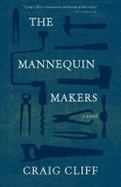
The Mannequin Makers : a Novel
- Binding: Paperback
- Publisher: Milkweed Editions
- Publish date: 09/01/2017
Description:
Chapter one In which Colton Kemp''s wife dies mid-morning, surrounded by misshapen mannequins Another wayward gouge stroke, another chunk of skin from his forefinger. This was always the way once the head had been roughed out, and three-quarter-inch gouge and carver''s mallet were exchanged for palm tools. Colton Kemp lifted the damaged digit to his mouth before the blood could surface, and held it there, stemming the flow and delaying the curses he''d hurl at his latest model. He''d named her Ursula but, like all his mannequins, even the men and children, she was modelled on his wife, Louisa. It had taken an hour to sculpt the preparatory clay maquette, but Louisa did not complain, did not move too much, despite being heavily pregnant. He looked at the maquette now, his finger still in his mouth, and could see the impressions of his thumbs in the miniature''s features. He had been at work since first light in the small two-cow barn he''d converted into a workshop three years ago. Despite the sun parading outside it was a gloomy place. A lamp hung from an exposed joist, casting unsteady light on Ursula''s unformed face. Friends from Christchurch and Dunedin told him the heads, if a mannequin had a head at all, were usually cast in wax. But this was Marumaru: different rules applied. In any case, he was yet to find the right consistency of wax that would hold up beneath the glare of the gas lamps in the street-front display windows of Donaldson''s department store. He''d also tried papier-m'ch and plaster of Paris but could not achieve the look of flesh with either. So it was wood -- heavy, stubborn wood -- and gouges, parting tools, veiners, fluters, sandpaper, nicks, cuts and frustration. Kemp''s shaky hands and rough temperament were ill suited to life as a carver, but it is curious the paths a life can take, the dead ends to which ambition and rivalry can lead a man. Every new mannequin represented several weeks'' work and even then he might uncover a knot or vicious grain when he peeled back the layers of the face. Or, just as likely, he would chip and sand away too much and, no matter how perfect the final expression, the head would be too small for the body he had constructed. His workshop was littered with such failures. Headless Hans holding a heavy canvas sheet in his uneven arms. Eager Mavis, with her lopsided breasts and overlarge mouth, would never don a ball gown. It was best not to think about them as he worked. Instead he held out hope that one day the face he revealed would be Louisa''s. Those thin, fair eyebrows that moved with every word, every thought. The cleft in her chin that disappeared upon closer inspection. Those big eyes, green giving way to blue and grey as she passed through the world. But how can you render the kindness of such a face, frozen in a single moment? It was maddening how her face eluded him in wood, but he had the consolation of finding it in the house whenever he laid down his tools. He grabbed Ursula''s broad wooden jaw between the pincers of his thumb and forefinger. Somewhere, he thought, still sucking the injured finger on his other hand. Somewhere in there is the strong-willed woman who doesn''t mind a spot of rain. At that moment he heard someone shout, ''Rain!'', or something very like it. He swung to face the door of his workshop and considered it much as he had the mannequin''s face, the puzzlement giving way to discomfort, anxiety, panic -- only then did he release the sliced finger from his mouth and set to heaving open the heavy, warped door. It took a moment for his eyes to adjust to the sunlight. There, beneath the bare wire clothesline, slumped over a load of washing, was . . . well, it was either Louisa, or her younger sister, Flossie. When Miss Florence had fled the kindness and condolences of Christchurch society and moved south to live with them six months ago, she had taken possession of three or four of Louisa''s older dresses. Kemp, despite plying his trade in window dressing, had trouble remembering which outfits were now the younger sister''s. He whispered, ''Please be Flossie,'' as he took his first step toward the clothesline. That one step was enough, however, to see the larger bulk and know it was Louisa. He ran to her, raised her gently. A patch of dark blood on the front of her dress had already soaked through to the freshly laundered sheets. The air smelt of soda and iron filings. ''I just wanted to get these on the line,'' she said, breathless, wincing. ''For Christ''s sake, Lou. Where''s Flossie? Flossie!'' he called and felt hoarse, as if he''d been yelling all morning. He looked back down at his wife. ''You shouldn''t have to hang out the damn washing.'' She winced once more. Her lids came down over her eyes. Her brows lifted and became fixed in place. ''Lou,'' he said. ''Lou, stay with me.'' The old lighthouse keeper''s dog chose this moment to crawl through the manuka thicket and cross the Kemps'' property. She stopped, considered the man and woman sitting on the lawn, before continuing on her way, three feet of rusted chain trailing between her legs. Kemp felt Louisa''s forehead, then stood and hauled his wife into the barn, onto the comfort of a pile of loose hay, wood shavings and sawdust several inches thick. He knelt behind her, propped her up against his own thighs. He mopped her brow with his sleeve, rocking back and forth. Louisa was silent. He watched the sawdust turn red between her legs. ''No,'' he said, softly, as if afraid of waking her. ''No, you can''t take her from me.'' He rocked back violently and knocked one of his abandoned mannequins, which sent a shiver through the ring of limbless, ill-proportioned, inanimate freaks watching over them in what he would later recall, in his bitter, driven future, as a pathetic travesty of the nativity scene. But in that moment Colton Kemp was lost, oblivious, blubbering. He placed a finger between his teeth to stop the tears and tasted blood. * * * Chapter two In which Sandow arrives in Marumaru, in a manner of speaking That same morning the train from the north deposited on the narrow platform a dark-skinned youth in shirtsleeves and a plaster statue wrapped in a dirty drop cloth. At Marumaru Station, this was enough to bring a crowd. Within two minutes the platform was thronged with townspeople eager to see what the youth had brought and for whom. ''It has the height of a man,'' said Fred Empson, the stationmaster. ''Perhaps it''s an Egyptian mummy,'' said the mayor, Big Jim Raymond. ''It must be returned to wherever it came from,'' said Mrs Harry Wisdom. ''There''s no place for heathenism in this town.'' ''It is not a mummy,'' said the youth, whose name was Jesse. He was not yet disconcerted by the way that time had sped since leaving Timaru, or the sight of green pastures from the station platform, or the lack of chimney stacks beyond the first few rows of houses. His first impression was instead reserved for the bold colours of the women''s dresses and the mayor''s hat, which looked as if it were covered with felt from a billiard table. In his newly acquired performing voice, Jesse announced, ''It is a statue of the perfect human form.'' He slipped a knot at the statue''s hip. ''It is--'' ''Sandow!'' shouted Big Jim Raymond. The crowd cheered and the deflated boy unwrapped the statue to reveal the figure they all expected, the one they''d seen in newspaper advertisements and on the cover of his very own magazine. There were his tight curls and Kaiser Wilhelm moustache, the abdominal muscles like coiled dock line. There the fig leaf covering his manhood, the Roman sandals, the head turned to admire his own bulging biceps. And, if there was any doubt, the pedestal proclaimed in patrician script that this was Sandow . As in Eugen Sandow, Sandow the Strongman, Sandow''s Spring-Grip Dumb-bells, Sandow''s Combined Developer, the Sandow Season that had swept through the nation''s newspapers, if not all of its drawing rooms, since the muscular Teuton had disembarked in Auckland among survivors of the wrecked Elingamite . Indeed, the commencement of his New Zealand tour had not been altogether auspicious. There was a general election in a week''s time, meaning there were no politicians to welcome him. Eugen Sandow, the strongest man on Earth, had had to push his way through the shattered survivors, their relieved and boisterous relatives and the silent bereaved to find his promoter, Harry Rickards, who had left Sydney a week before to make final arrangements in the new colony. Sandow would later admit to Jesse that he had expected New Zealand to be nothing more than a collection of wooden huts hastily erected by castaways from the world''s four corners, men with wild beards and women perpetually with child who cared not for news from the next hut over, let alone the heart of civilisation. ''But I have been pleasantly surprised,'' Sandow had said, ''by the people of your country, the development of their bodies and the commerce evident on every street corner. And of course, they know who I am, which cannot help but make me favourably disposed.'' Sandow was the big draw for Rickards'' Vaudeville Company, which went on to fill town halls and opera houses in Auckland, New Plymouth, Stratford, Wanganui, Palmerston North, Masterton, Napier, Wellington, Christchurch, Ashburton and Timaru. Before each show a life-sized plaster replica of Sandow was sent ahead to heighten anticipation. But Eugen Sandow was never meant to c
Expand description


Please Wait