Due to planned maintenance, your school has disabled school system log-ins at this time.
You may continue shopping as a guest, or by creating a bookstore-only account.
Please complete the purchase of any items in your cart before going to this third-party site.
Also note that if you qualify for financial aid, items purchased through this site will not be subject to
reimbursement.
164 pages. The Scottish author's second book. First edition (first printing),
[...]
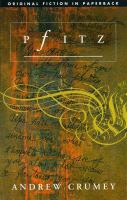
164 pages. The Scottish author's second book. First edition (first printing), a paperback original. A fine copy in wrappers (paperback). Signed by the author. "Pfitz is a surprisingly warm and likeable book, a combination of intellectual high-wire act and good traditional storytelling with a population of lovers and madmen we do care about, despite their advertised fictionality. Certainly Crumey's narrative gymnastics have not affected his ability to create strong, fleshy characters, and none more fleshy, more fleshly, than Frau Luppen, Schenck's middle-aged landlady, a great blown rose of a woman who express her affection for her lodger by feeding him bowls of inedible stew." Andrew Miller in The New York Times "Rreinnstadt is a place which exists nowhere-the conception of a 18th century prince who devotes his time, and that of his subjects, to laying down on paper the architecture and street-plans of this great, yet illusory city. Its inhabitants must also be devised: artists and authors, their fictional lives and works, all concocted by different departments. When Schenck, a worker in the Cartography Office, discovers the 'existence' of Pfitz, a manservant visiting Rreinnstadt, he sets about illicitly recreating Pfitz's life. Crumey is a daring writer: using the stuff of fairy tales, he ponders the difference between fact and fiction, weaving together philosophy and fantasy to create a magical, witty novel." Sunday Times.
164 pages. The Scottish author's second book. First edition (first printing),
[...]
164 pages. The Scottish author's second book. First edition (first printing), a paperback original. A fine copy in wrappers (paperback). Signed by the author. "Pfitz is a surprisingly warm and likeable book, a combination of intellectual high-wire act and good traditional storytelling with a population of lovers and madmen we do care about, despite their advertised fictionality. Certainly Crumey's narrative gymnastics have not affected his ability to create strong, fleshy characters, and none more fleshy, more fleshly, than Frau Luppen, Schenck's middle-aged landlady, a great blown rose of a woman who express her affection for her lodger by feeding him bowls of inedible stew." Andrew Miller in The New York Times "Rreinnstadt is a place which exists nowhere-the conception of a 18th century prince who devotes his time, and that of his subjects, to laying down on paper the architecture and street-plans of this great, yet illusory city. Its inhabitants must also be devised: artists and authors, their fictional lives and works, all concocted by different departments. When Schenck, a worker in the Cartography Office, discovers the 'existence' of Pfitz, a manservant visiting Rreinnstadt, he sets about illicitly recreating Pfitz's life. Crumey is a daring writer: using the stuff of fairy tales, he ponders the difference between fact and fiction, weaving together philosophy and fantasy to create a magical, witty novel." Sunday Times.
164 pages. The Scottish author's second book. First edition (first printing),
[...]
164 pages. The Scottish author's second book. First edition (first printing), a paperback original. A fine copy in wrappers (paperback). Signed by the author. "Pfitz is a surprisingly warm and likeable book, a combination of intellectual high-wire act and good traditional storytelling with a population of lovers and madmen we do care about, despite their advertised fictionality. Certainly Crumey's narrative gymnastics have not affected his ability to create strong, fleshy characters, and none more fleshy, more fleshly, than Frau Luppen, Schenck's middle-aged landlady, a great blown rose of a woman who express her affection for her lodger by feeding him bowls of inedible stew." Andrew Miller in The New York Times "Rreinnstadt is a place which exists nowhere-the conception of a 18th century prince who devotes his time, and that of his subjects, to laying down on paper the architecture and street-plans of this great, yet illusory city. Its inhabitants must also be devised: artists and authors, their fictional lives and works, all concocted by different departments. When Schenck, a worker in the Cartography Office, discovers the 'existence' of Pfitz, a manservant visiting Rreinnstadt, he sets about illicitly recreating Pfitz's life. Crumey is a daring writer: using the stuff of fairy tales, he ponders the difference between fact and fiction, weaving together philosophy and fantasy to create a magical, witty novel." Sunday Times.
Signed Copy First edition copy. Collectible-Very Good. Signed by author on title page. In protective mylar cover. (fiction, historical fiction, mystery)
Signed Copy First edition copy. Collectible-Very Good. Signed by author on title page. In protective mylar cover. (fiction, historical fiction, mystery)
Signed Copy First edition copy. Collectible-Very Good. Signed by author on title page. In protective mylar cover. (fiction, historical fiction, mystery)
Signed Copy First edition copy. Collectible-Very Good. Signed by author on title page. In protective mylar cover. (fiction, historical fiction, mystery)