
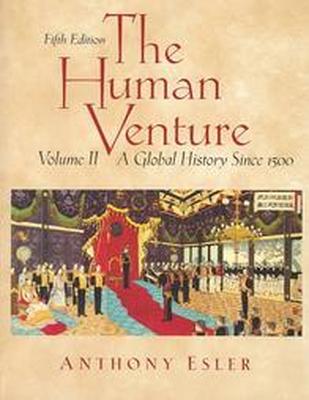
Human Venture, the a Global History, Volume 2 (since 1500)
- List Price: $153.32
- Binding: Paperback
- Edition: 5
- Publisher: Pearson
- Publish date: 07/02/2003
Description:
Prefaces are always challenging, and the prefaces to this book seem to get more challenging with each new edition. For a preface is at least in part a look ahead. And in the opening years of the twenty-first century, the global prospect before us looks less predictable than ever. This fifth edition of The Human Venture, like its predecessors, attempts to provide a historical background to the changing world of today. Like earlier editions, this one tries to offer a genuinely global perspective, rather than a European history with add-ons about other cultures. It still aims at the broadest possible coverage--coverage of women as well as of men, of preurban as well as of urban-imperial peoples, of culture as well as of politics. It still tries to humanize the past with emphasis on the historical roles of individual human beings, from ancient emperors to laboring peasants. And this particular version of our global past still builds on a strong narrative line that reflects the nature of history as the author sees it--as a story going somewhere, obscure though that somewhere may still be to the principal historical actors--us. A major goal of this new edition has been to adapt the book more closely to the requirements of classroom teaching and learning. The number of chapters, for instance, has been reduced from fifty to thirty--roughly the number of weeks in many academic years. This change, I hasten to add, has been largely accomplished by combining chapters, not by cutting! All chapters have again been revised, and each now has a new theme-setting "Glance Ahead" opener and a substantially updated bibliography. There are also some new maps, some new pictures, and a new emphasis on the "Voices from the Past" boxes--one for each chapter now. The "Overviews" introducing each of the six large sections into which the book is divided have also been revised, and a new big-picture time line appended to each. And the book as a whole has been redesigned in a "trade-book" format that I hope will be easier for the reader to hold while absorbing the carefully digested insights of twenty-five centuries of historians from many times and lands. Once more, I have included the odd anecdote and I hope some new insights picked up during the three months or more I spend overseas each year. Several weeks each on the upper Amazon, across the Outback and the Top End of Australia, in the Northwest Frontier Province of Pakistan, and among the ethnic minority villages of western China have certainly added to my respect for the indigenous peoples of the world. And annual visits to familiar neighborhoods in favorite European cities serve as a healthy reminder that the peoples of the developed world have a lot to teach each other too. A key function of the preface, finally, remains to express proper gratitude to the many people without whom there would be no book at all. Here a primary debt must be to Charles Cavaliere, the new Prentice Hall history editor, for injecting a surge of youthful dynamism into this particular venture into the human past. Many thanks also to Emsal Hasan and Patty Donovan for getting me through the hard part--finishing--and to Adrienne Paul for handling every unlikely request of mine effectively and expeditiously. Without the shared insights and shrewd criticisms of scholarly readers, of course, a synthesis as broad as this would be impossible. My thanks, then, to Kenneth Wilburn, East Carolina University; Louis McDermott, California Maritime Academy; Trevor Getz, University of New Orleans; Robert Garfield, DePaul University; and Pamela McVay, Ursuline College. Thanks for past critical readings should also go to Akanmu G. Adebayo, Kennesaw State University; Alana Cain Scott, Morehead State University; Elizabeth C. George, Southern Illinois University; Farid Mahdavi-Izadi, San Diego State University; Linda L. Taber, Wayne State University; Joe Gowaskie, Rider College; John Voll, University of New Hampshire; Penny S. Gold, Knox College; Walter S. Hanchett, SUNY/Cortland; Donald L. Layton, Indiana State University; Melvin E. Page, Murray State University; Susan Fitzpatrick, Lindenwood College; Curtis Anderson, Oakland Community College; Dorothy Zeisler-Vralsted, University of Wisconsin, La Crosse; Ed Balog and James Hood, Lindenwood College; James Weland and Nancy R. Northrup, Bentley College; Thomas Anderson, Eastern Connecticut State University; Howard A. Barnes, Winston Salem University; Olwyn M. Blouet, Virginia State University; Robert Garfield, De Paul University; W. Scott Jessee, Appalachian State University; Gerald Newman, Kent State University; and John A. Phillips, University of California-Riverside. Thanks again to scholars who have patiently labored to educate me over the years, including Marjorie W. Bingham of Women in World Area Studies; Mario D. Mazzarella and the Department of History at Christopher Newport College; J. F. Watts and the faculty of the trailblazing World Civilization course at City College of New York; Richard Snyder, William Pemberton, and the landmark World History program at the University of Wisconsin, La Crosse; and Bill Alexander, Cassandra Newby, and Jeanne Zeidler of Hampton University. As always, my thanks must go to friends and colleagues here at William and Mary, who do their best to correct the sweeping generalizations I bring to the acid test of their expertise. For many years of help, my thanks to Ismail Abdalla, Berhanu Abegaz, Jim Axtell, Craig Canning, John Carroll, Ed Crapol, Judy Ewell, A. Z. Freeman, Phil Funigiello, Dale Hoak, Ward Jones, Kris Lane, Gil McArthur, Jim McCord, Leisa Meyer, Ed Pratt, Abdul Karim Rafeq, Ernie Schwintzer, John Selby, Tom Sheppard, Rich Sigwalt, George Strong, Cam Walker, and Jim Whittenburg. For introductions to some fascinating corners of the world, my thanks to Steve and Peggy Brush, for Peru when things were much too exciting to be saddled with a guest as well; to Professor Dong Leshan, of the Chinese Academy of Social Sciences; to Chris Drake, for showing me how to look at the African land; to Carol Clemeau Esler, for all the village-level sojourns in Europe; to Marcia Davidson Field, for her insights into Latin America over many years; to Richard Goff, for caustic comments and sage council along the Atlantic; to Professor Isaria N. Kimambo, of the University of Dar es Salaam, for insights into African historiography; to Ross Kreamer for Java, Sumatra, and Vietnam; to Chris Mullen Kreamer, for sharing her remarkable "African destiny"; to Steve and Ann Marlowe, for expat Europe and much more; to Don Meyer, for Benares, the Ganges, and the border roads of India; to Ernie Schwintzer and Alice Davenport for Jakarta in tense times; and to Jerry Weiner, for running a tight ship from Abidjan to Zanzibar. And thanks again to Cam Walker, who keeps coming up with amazing places we haven''t ever been--two different versions of Shangri-la so far!--but never lets anything get in the way of that evening trip to the corner cafe. Anthony Esler
Expand description

Please Wait