
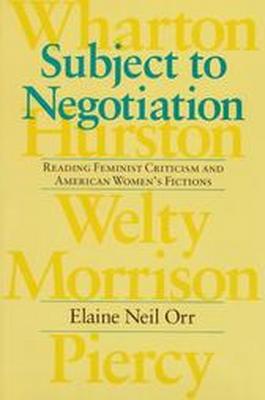
Subject to Negotiation Reading Feminist Criticism and American Women's Fictions
- Binding: Hardcover
- Publisher: Univ of Virginia Pr
- Publish date: 06/01/1997
In the author's hybrid theory. "negotiation" constitutes not fractious debates between opposing parties but noisy dialogues between and among subjects whose complex identities overlap a number of opposing positions. Not surprisingly, Orr draws from literary critics writing out of working-class, African-American, Chicana, lesbian, and postcolonial identities, as well as white and academic ones. What is surprising, she claims, is how five representative American women writers -- Edith Wharton, Zora Neale Hurston, Eudora Welty, Toni Morrison, and Marge Piercy -- demonstrate the very critical and philosophical movements we see in contemporary feminist criticism. Feminist critics, like these writers and their panorama of characters, are necessarily operating between scenes of power, negotiating their interests across uneven fields. As Orr demonstrates, American women writers have produced "negotiating narratives" to accommodate the expectations of their readership while simultaneously contesting the boundaries of female subjectivity.
Subject to Negotiation makes compelling reading for scholars of feminist literary theory, aswell as those interested in twentieth-century American literature, debates over identity politics, and theories of narrative.