
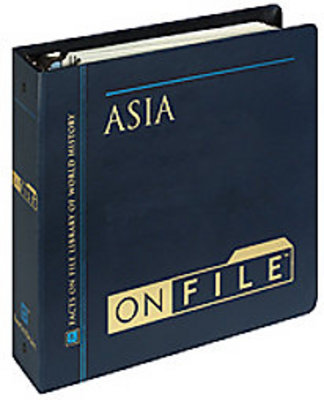
Asia on File
- List Price: $185.00
- Binding: Hardcover
- Publisher: Facts on File
- Publish date: 12/01/1996
-- Instructors can use the pages for handouts, overheads, posters, and testing.
-- Students can use them as quick sources of information, to reference curriculum topics, or to supplement their essays and reports.
-- On Files "TM" are available in either binder or electronic format.
Created to meet the major requirements of the National Geography Standards and updated periodically to remain a current source of information, the Regional Geography On File "TM" series assembles a contemporary, authoritative mosaic of the human and physical geography of the world's many nations.
Arranged by Continent
By integrating such diverse fields as demography, economics, and politics, each binder provides an interdisciplinary set of maps, charts, and diagrams:
Maps:
-- Political
-- Administrative
-- Physical Features
-- Land Use & Agriculture
-- Industry & Mining
Charts & Diagrams:
-- Fact Sheet & Government Chart: provides basic information, such as land area, current population estimates, terrain, religion, race and ethnicity, and government structure
-- Timeline: outlines the nation's history and places it in context of world events
-- Culture & Everyday Life Chart: describes prominent features of daily life, such as conversation, food, dress, family and friends, school life, and celebrations
-- Economic Statistics: highlight the major trends that each country has experienced and is experiencing. Standard EconomicIndicators include GNP, GDP, Consumer Price Index, and Inflation data
-- Demographic Indicators: include past and projected population growth, birth and death rates, age and gender breakdowns, religion, race, and ethnicity.
Designed with an interdisciplinary focus, Asia On File "TM" provides librarians and researchers with a one-stop reference on this increasingly important area.
The "Contemporary Regional Issues" section features:
-- Population density and growth
-- Economic growth and trade
-- Language groups
-- Water resources
-- Storms and storm patterns
-- Ethnic groups
-- Religions
-- Border disputes and disputed territories
-- Internal migration
-- Education
-- Health
-- Women's issues
-- Tibet and other struggles for autonomy
-- Deforestation.