
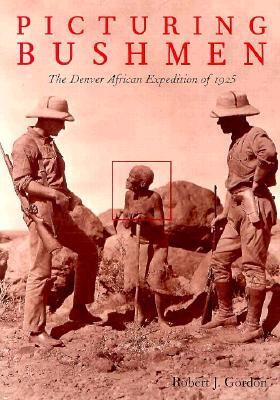
Picturing Bushmen the Denver African Expedition of 1925
- Binding: Paperback
- Publisher: Ohio Univ Pr
- Publish date: 05/01/1997
In this innovative study of bushman imagery, Robert Gordon focuses on a particular event, the Denver African Expedition of 1925, which went off to Africa to "seek the cradle of Humanity". The participants claimed to have found the "Missing Link" in the Heikum Bushmen of the Etosha Game Park and, because the Expedition was a commercial venture, its backers marketed this image.
Gordon, an anthropologist, examines the "culture of visualization" that gave direction to the expedition and was in turn influenced by it. Because the pictures from the Denver Expedition were aesthetically pleasing, they encouraged widespread merchandising of bushman images, which, in turn, had unanticipated consequences.
Picturing Bushmen ventures beyond traditional boundaries of area studies, visual theory, and academic anthropology to press for an appreciation of the familiar as well as the spectacular. In evaluating the role of the "ethnic photograph", it addresses the perennial questions that haunts field workers: How much are they influenced by the mundane in their own society and when are they exploiting their subjects?
"It is easy to fall into the error of regarding the Bushmen as more primitive than they really were". -- J. S. Marais, 1939