Due to planned maintenance, your school has disabled school system log-ins at this time.
You may continue shopping as a guest, or by creating a bookstore-only account.
Please complete the purchase of any items in your cart before going to this third-party site.
Also note that if you qualify for financial aid, items purchased through this site will not be subject to
reimbursement.
Good-Bumped and creased book with tears to the extremities, but not affecting
[...]
Good-Bumped and creased book with tears to the extremities, but not affecting the text block, may have remainder mark or previous owner's name-GOOD PAPERBACK Standard-sized.
You are licensing a digital product for a set duration.
Durations are set forth in the product description, with "Lifetime" typically meaning five (5) years of online access and permanent download to a supported device.
All licenses are non-transferrable.
More details can be found here. May come without consumable supplements like access codes, CD's, or workbooks.
Description:
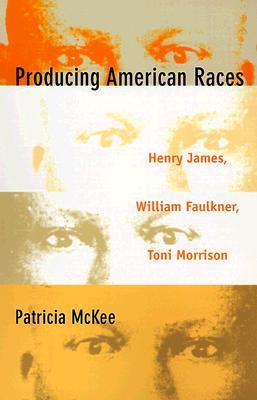
In Producing American Races Patricia McKee examines three authors who have powerfully influenced the formation of racial identities in the United States: Henry James, William Faulkner, and Toni Morrison. Using their work to argue that race becomes visible only through image production and exchange, McKee illuminates the significance that representational practice has had in the process of racial construction.
McKee provides close readings of six novels -- Jame's The Wings of the Dove and The Golden Bowl, Faulkner's The Sound and the Fury and Light in August, and Morrison's Sula and Jazz -- interspersed with excursions into Lacanian and Freudian theory, critical race theory, epistemology, and theories of visuality. In James and Faulkner, she finds, race is represented visually through media that highlight ways of seeing and being seen. Written in the early twentieth century, the novels of James and Faulkner reveal how whiteness depended on visual culture even before film and television became its predominant media. In Morrison, the culture is aural and oral -- and often about the absence of the visual. Because Morrison's African American communities produce identity in nonvisual, even anti-visual terms, McKee argues, they refute not just white representations of black persons as objects but also visual orders of representation that have constructed whites as subjects and blacks as objects.
Expand description
Product notice
Returnable at the third party seller's discretion and may come without consumable supplements like access codes, CD's, or workbooks.
Good-Bumped and creased book with tears to the extremities, but not affecting
[...]
Good-Bumped and creased book with tears to the extremities, but not affecting the text block, may have remainder mark or previous owner's name-GOOD PAPERBACK Standard-sized.
Good-Bumped and creased book with tears to the extremities, but not affecting
[...]
Good-Bumped and creased book with tears to the extremities, but not affecting the text block, may have remainder mark or previous owner's name-GOOD PAPERBACK Standard-sized.
Connecting readers with great books since 1972! Used books may not include
[...]
Connecting readers with great books since 1972! Used books may not include companion materials, and may have some shelf wear or limited writing. We ship orders daily and Customer Service is our top priority!
Connecting readers with great books since 1972! Used books may not include
[...]
Connecting readers with great books since 1972! Used books may not include companion materials, and may have some shelf wear or limited writing. We ship orders daily and Customer Service is our top priority!