
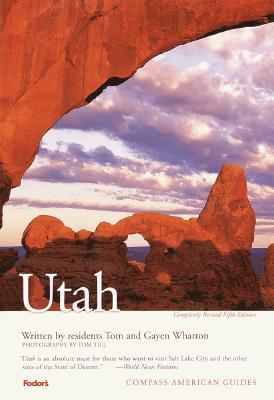
Compass American Guides Utah
- List Price: $21.00
- Binding: Paperback
- Edition: 0005
- Publisher: Random House Inc
- Publish date: 02/01/2001
Description:
STORIES IN STONE There are many ways to contemplate the geological forces which have shaped Utah. Hike to the top of an alpine peak overlooking the Great Salt Lake Valley and look down on the sprawling metropolitan area. Drive across the desolate Bonneville Salt Flats, where mirages of floating mountains and disappearing lakes shimmer across the glistening, salt-encrusted surface. Listen to the roar of the rapids on a raft trip through Cataract Canyon and watch the colors and shapes of steep sandstone ledges change dramatically along the way. Then fly back over the same country and look out over the convoluted canyons, stately fins, windblown arches, and rock bridges formed by erosion. Wander down a remote, narrow canyon in Zion National Park. Examine the texture of the sandstone closely; feel the warm, red rock with your hands. Ascend an almost vertical cliff. Lie on a hard, smooth rock surface, and study the countless hues. Nowhere in the world, perhaps, have the elements of earth, wind, and water come together with such drama. Underground forces have heaved and pushed massive plateaus and mountain ranges up more than a mile above sea level. Erosion continues to cut and gouge plateaus into spectacular pinnacles and canyons. The Colorado Plateau The Colorado Plateau covers all of southeastern Utah. It also extends into adjacent areas drained by the Colorado River in Colorado, New Mexico, and Arizona. This sparsely vegetated landscape of plateaus, mesas, deep canyons, sloping foothills, imposing vertical cliffs, and barren badlands contains some of the world's most unusual scenery. "Here," wrote William Lee Stokes, "is a kingdom of rocks, an arena where the elemental forces of time and weather meet the raw stuff of the earth with nothing to soften or hide the scars of battle." On the western edge of the Colorado Plateau are eight plateaus ranging in elevation from 8,000 to 11,000 feet (2,425-3,330 m). These run southerly from near the center of the state, with the drainage about equally divided between the Great Basin and the Colorado River. Brian Head Ski Resort, south of Parowan, sits atop such a plateau. Nearby are Bryce Canyon National Park, Cedar Breaks National Monument, and Escalante Grand Staircase National Monument. In fact, since all of Utah's five national parks are found on the Colorado Plateau, visiting any will help you understand the forces that form this unique and beautiful part of the world. Geological guides are sold at each park visitor center, and there are also interpretive signs along the roads.
Expand description

Please Wait