
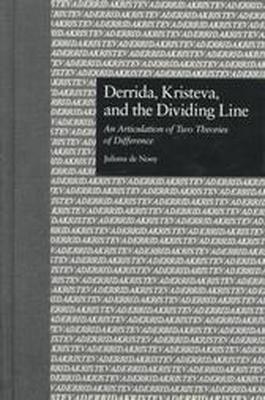
Derrida, Kristeva, and the Dividing Line an Articulation of Two Theories of Difference
- List Price: $140.00
- Binding: Hardcover
- Publisher: Taylor & Francis
- Publish date: 08/01/1998
This book aims at establishing precisely how Kristeva's and Derrida's writings may be articulated, tracing intersections and divergences, parallels and discontinuities between them. But how do you compare two theories of the production of difference? What conception of difference do you use to go about it? Any search for a dividing line between Derrida and Kristeva already engages with their preoccupations. Should the juxtaposition of these practices be conceived as a face-to-face confrontation or rather a gap, a hiatus? Could it be a dialectic? or a differance? Should it be thought of in terms of Kristeva's work ... or Derrida's?
Accessible and lively, this book studies the theories on their own terms, in terms of one another, and with regard to the literary text, a privileged object of their attention. It demonstrates that the articulation of the theories shifts under different discursive conditions such that a Derridean reading of the relation is unlikely to coincide with a Kristevan interpretation. It shows why there is no single answer to the question of how the two fit together. And it investigates what is at stake in the strategic uses to which their work is put, whether separately or together.