
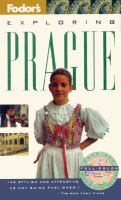
Fodor's Exploring Prague
- List Price: $22.00
- Binding: Paperback
- Publisher: Fodor's Travel Publications
- Publish date: 01/01/2002
Description:
Prague Is ... The Mother of Cities Restored to the heart of Europe by the Velvet Revolution of 1989, the capital of the Czech Republic more than lives up to its reputation as the most beautiful city north of the Alps. The city''s incomparable architectural heritage spans a thousand years of history, while its political, economic, and cultural life is being rejuvenated by the release of the energies pent up by the long decades of Communism. Magical Beauty Prague is a true metropolis -- large (population 1,250,000) but not so large that it cannot be grasped as a whole. The focus of national life since the early Slav princes built their stronghold on the Hradcany heights, the city has no rival for significance or size in the Czech Republic. The four historic quarters of Hradcany, Mal Strana, Star Mesto (Old Town), and Nov Mesto (New Town) contain buildings of every era in neighborly proximity to one another. The elegance of the baroque age may seem to predominate, but there are monuments from every phase of the city''s history, spared from war and redevelopment to form one of the most harmonious townscapes in Europe. Prague Is ... People The vast majority of Prague''s million and a quarter inhabitants are native Czechs, the westernmost of all the Slav peoples. It still hurts some of them to be described as Eastern Europeans; if you do so, you are likely to be reminded that Prague lies a long way west of Vienna, and that for most of its history the country has been firmly tied to a Western world which it is now, not without pain, doing its best to re-enter. Central Europeans As you observe Praguers going about their business, you are likely to notice all kinds of contrasting characteristics. There are traces of Habsburg formality in the use of "Doctor this" and "Professor that," though you won''t see much kissing of hands. If you understand the language you will notice that people use "Sir" and "Madam" instead of the once-pervasive "Comrad," and no one, not even in the head office of the reformed Communist Party, uses the greeting "Honor to Work!" anymore. Manners and ways of doing things generally are Central European and different from, say, American or French, though many Czechs pride themselves, especially since 1989, on their informality. Communism has left an overlay of apparent rudeness and indifference which is not characteristically Czech, but which persists among some waiters and shop assistants, the kind whose day is made when they tell the customer that something is unobtainable. It would be a mistake to think of Czechs as fiery Slavs. Their history has taught them to keep their heads down, and to make an ironic comment or joke rather than declaim a passionate speech. Subverting the system rather than confronting it head-on seemed a sensible approach when rulers held all the cards that counted. After 1968, most people concentrated on their private lives, making sure there was enough money to pay for the car, the cottage in the country and the occasional foreign vacation, leaving protest to a handful of diehard dissidents. Prague Is ... Not What It Was Under Communism, Prague sometimes seemed more gray than golden, its drabness relieved on occasion by a rash of red banners proclaiming "Towards a Happy Future with The Soviet Union" or "Work, Learn and Live for the Progress of our Socialist Republic." Since 1989, however, the street scene has become a kaleidoscope of color promoting the products of an international economy long craved for by the Czechs. Consumer City Among the items the Communist order failed to deliver in sufficient quantity and variety was paint. Showpiece buildings might have received their quota of retouching, but most faades remained a slowly darkening shade of elephant gray. What color there was really stood out, like the red and yellow of the city''s trams, or the variegrated parkas and satchels of a line of schoolchildren. The public transportation department has now transformed some of its vehicles into mobile billboards for cigarettes and computers. New owners have given their old buildings their first coat of paint in 50 years, and the Communist slogans, which no one read anyway, have given way to infinitely more persuasive promises of happiness, courtesy of Coca-Cola, Benetton, McDonald''s, Marlboro, Bitburger... Bazaars and Bars The townscape has been further enlivened by the opening of countless bars, boutiques, bureaux de change, shops, cafs and restaurants, each with their own advertisements, displays, or inventive menu cards. In front of the new shops, much to the annoyance of the owners, stand hopeful street traders offering everything from T-shirts to smuggled cigarettes (although their numbers have been greatly reduced in recent years). Conceived originally as a way of crossing the river, Karluv most (Charles Bridge) has now become a bazaar where crowds of tourists are offered souvenirs, entertained by street performers, or relieved of the contents of their wallets and purses by pickpockets. Press Released The return of press freedom has made life easier for the visitor from abroad, as well as packing the news kiosks with any number of new titles. No longer does the tourist have to make do with the turgid texts of such party-approved papers as London''s Morning Star or East Berlin''s Neues Deutschland ; newspapers are now available from all over the world. Local publications cater to all tastes, though the appetite for crude home-grown porn, printed on what looks like blotting paper, seems to be waning.
Expand description

Please Wait