
Due to planned maintenance, your school has disabled school system log-ins at this time.
You may continue shopping as a guest, or by creating a bookstore-only account.
Please complete the purchase of any items in your cart before going to this third-party site.
Also note that if you qualify for financial aid, items purchased through this site will not be subject to
reimbursement.
You are purchasing a license to access this digital product—not ownership of the content.
Access durations vary by product.
eBooks labeled "Lifetime" provide permanent online access along with the option to permanently download the content to a supported device.
Publishers may set shorter access periods and license durations for course materials accessed and hosted through their websites. Please confirm license duration and support directly with these publishers.
American Academy Holdings, Editora Manole, and Forum for International Trade Training have requested that we support "Lifetime" licenses with different durations. Please confirm license duration and support directly with these publishers.
All licenses are non-transferrable and may be revoked if VitalSource or its partners no longer hold rights to the content.
Learn more about our digital license terms on this support page.
Description:
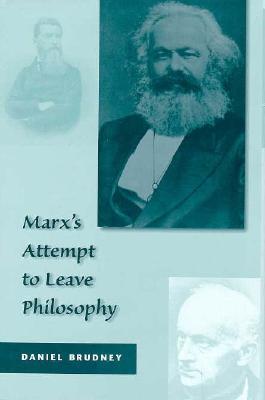
Daniel Brudney traces the development of post-Hegelian thought from Ludwig Feuerbach through Bruno Bauer to Karl Marx's work of 1844 and his Theses on Feuerbach, and concludes with an examination of The German Ideology. Brudney focuses on the transmutations of a set of ideas about human nature, the good life, and our relation to the world and to others; about how we end up with false beliefs about these matters; about whether one can, in a capitalist society, know the truth about these matters; and about the critique of capitalism which would flow from such knowledge.
Brudney shows how Marx, following Feuerbach, attempts to reveal humanity's nature and what would count as the good life, while eschewing and indeed polemicizing against "philosophy" -- against any concern with metaphysics and epistemology. Marx attempted to avoid philosophy as early as 1844, and the central aims of his texts are the same right through The German Ideology. There is thus no break between an early and a late Marx; moreover, there is no "materialist" Marx, no Marx who subscribes to a metaphysical view, even in The German Ideology, the text canonically taken as the origin of Marxist materialism. Rather, in all the texts of this period Marx tries to mount a compelling critique of the present while altogether avoiding the dilemmas central to philosophy in the modern era.

Expand description
This seller ships with tracking when standard shipping is selected.
Please Wait
Notify Me When Available
Enter your email address below, and we'll contact you when your school
adds course materials for .
Enter your email address below, and we'll contact you
when is back in stock
(ISBN: ).