
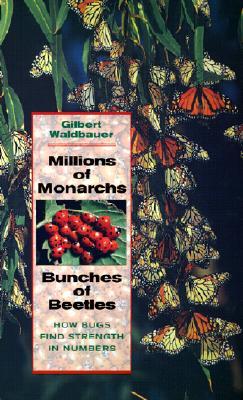
Millions of Monarchs, Bunches of Beetles How Bugs Find Strength in Numbers
- Binding: Paperback
- Publisher: Harvard Univ Pr
- Publish date: 10/01/2001
The groups that Gilbert Waldbauer discusses here are not as complex or tightly organized as the better-known societies of termites, wasps, ants, and bees. Some, like the mayflies, come together merely because they emerge from the water in the same place at the same time. But others, like swarms of locusts, are loosely organized, the individual insects congregating to migrate together for distances of hundreds of miles. And yet others form a simple cooperative society, such as the colony of tent caterpillars that weaves a silken tent to house the whole group.
Waldbauer tells us how individuals in these and other insect aggregations communicate (or don't), how they coordinate their efforts, how some congregate the better to mate, how some groups improve the temperature and humidity of their microenvironment, and how others safeguard themselves (or the future of their kind) by amassing in such vast numbers as to confound predators.
As engaging and authoritative as Waldbauer's previous books, Millions of Monarchs, Bunches of Beetles will enlighten and delight those who know their insects well and those who wish to know them better.