
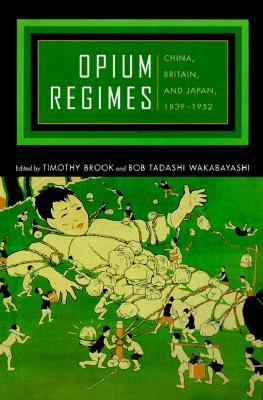
Opium Regimes China, Britain, and Japan, 1839-1952
- Binding: Paperback
- Publisher: Univ of California Pr
- Publish date: 08/01/2000
Description:
Opium is more than just a drug extracted from poppies. Over the past two centuries it has been a palliative medicine, an addictive substance, a high-value commodity, a powerful mechanism for concentrating and transferring wealth and power between nations, and the anchor of a now vanished sociocultural world in and around China. Opium Regimes integrates the pioneering research of sixteen scholars to show that the opium trade was not purely a British operation but involved Chinese merchants, Chinese state agents, and Japanese imperialists as well. The book presents a coherent historical arc that moves from British imperialism in the nineteenth century to Chinese capital formation and state making at the turn of the century to Japanese imperialism through the 1930s and 1940s and finally to the apparent resolution of China's opium problem in the early 1950s.
Expand description
Avoiding the Eurocentric focus of earlier approaches, this volume relies on the concept of "opium regimes" in Asia -- the regional and local systems that states, corporations, and civic associations set up either to profit from or suppress the opium trade. By focusing on these opium regimes, the authors are able to investigate the systematic and comprehensive character of drug-control structures, stressing their capacity for operating in the political realm. The complex interweaving of commodity trading, addiction, and state intervention in opium's history refigured the historical face of East Asia more profoundly than any other commodity.
Product notice
Returnable at the third party seller's discretion and may come without consumable supplements like access codes, CD's, or workbooks.


Please Wait