
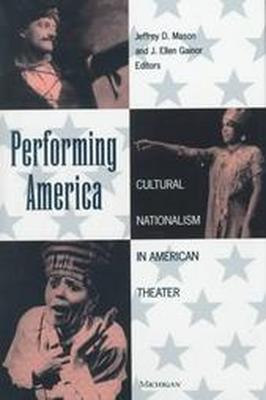
Performing America: Cultural Nationalism in American Theater
- Binding: Hardcover
- Publisher: University of Michigan Press
- Publish date: 01/01/2001
The topics covered include the links between politics and the stage during the Federalist period, the appropriation of "Indian" artifacts, an exploration of early gender roles, and the metaphorical connections between the theater and western expansion. Other essays treat vaudeville's artistically colonized cultures; Chautauqua's attempt to homogenize culture and commercialize American ideals; W. E. B. Du Bois's pageant, The Star of Ethiopia, as a strategy for constructing "African-American" as "Other" in an attempt to promote a vision of black nationalism; and how theater was used to help immigrants form a new sense of community while joining the resident culture.
The collection then turns to questions of how various ethnic minorities through their recent theatrical work have struggled to argue their identities, especially in relation to the dominant white culture. Two final essays offer critiques of contrasting aspects of the American male.
Throughout, the collection addresses questions of marginality and community, exclusion and inclusion, colonialism and imperialism, heterogeneity and homogeneity, conflict and negotiation, repression and opportunity, failure and success, and, above all, the relationship of American stages at large.