
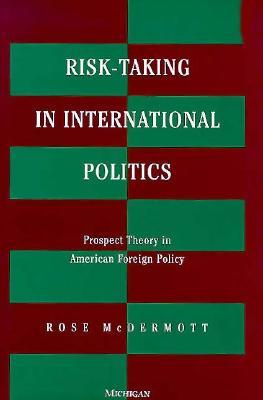
Risk-Taking in International Politics Prospect Theory in American Foreign Policy
- Binding: Hardcover
- Publisher: Univ of Michigan Pr
- Publish date: 03/01/1998
Rose McDermott applies prospect theory, a theory developed by psychologists to understand decisionmaking under conditions of risk, to four cases in American foreign policy. Prospect theory suggests that decisionmakers who are confronting losses are more likely to take risks than are those decisionmakers who are satisfied with the status quo. The cases used to demonstrate this dynamic include: the Suez Crisis, the U-2 affair, the decisions surrounding the admission of the Shah of Iran to the United States in 1979, and the attempted rescue of the American hostages in Iran in 1980. McDermott shows how prospect theory enables us to understand cases that are otherwise inexplicable.
Risk Taking in International Relations offers a unique application of a sophisticated psychological model to international relations theory. The book will be of interest to political scientists and psychologists interested in decision making, in international relations and in American foreign policy.