
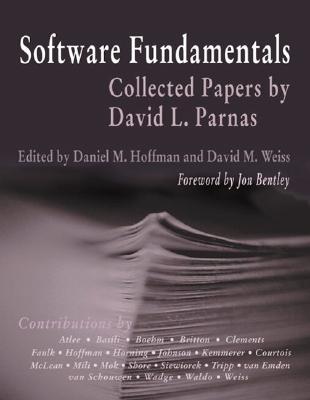
Software Fundamentals: Collected Papers by David L. Parnas
- Binding: Paperback
- Edition: 1
- Publisher: Addison-Wesley Professional
- Publish date: 04/09/2001
Description:
Foreword. Preface. I. DESCRIPTION AND SPECIFICATION. David Lorge Parnas, P.Eng. 1. Using Assertions About Traces to Write Abstract Specifications for Software Modules (Wolfram Bartussek and David L. Parnas). Introduction. A FormalNotation for Specification Based on Traces. Some Simple Examples. Discussion of the Simple Examples. A Compressed History of the Development of an Abstract Specification. Conclusions. 2. Less Restrictive Constructs for Structured Programs (David L. Parnas and William Wadge). Abstract. Introduction. The State of a Computing Machine. Programs. Program Specifications. Primitive Programs. Control Constructs and Constructed Programs. Defining the Semantics of Constructed Programs. The Value of a Program. The Syntax of the Constructs. Notation. Guard Semantics. The Semantics of a Limited Component. The Semantics of Limited Component Lists. The Semantics of ";". The Semantics of "stop", "go" and "init". Semantics of the Iterative Construct (it ti). The Semantics of Parentheses. The Value of "#". The Value Stack. Exits and Entrances. A Very Simple Example Done Three Ways. The DEED Problem. Conclusions. 3. Predicate Logic for Software Engineering (David Lorge Parnas). Abstract. Introduction. The Structure of This Paper. Comparison with Other Work. Basic Definitions. The Syntax of Logical Expressions. The Meaning of Logical Expressions. Examples of the Use of This Logic in Software Documentation. Conclusions. 4. Tabular Representations in Relational Documents (Ryszard Janicki, David Lorge Parnas, Jeffery Zucker). Abstract. A Relational Model of Documentation. Industrial Experience with Relational Documentation. Why Use Tabular Representations of Relations? Formalisation of a Wide Class of Tables. Transformations of Tables of One Kind to Another. Conclusions. 5. Precise Description and Specification of Software (D. L. Parnas). Abstract. On Foundational Research. Language Is Not the Issue. A Polemic About Four Words. Four Types of Software Products. Programs and Executions. A Mathematical Interlude: LD-Relations. Program Construction Tools. Describing Programs. Specifying Programs. Objects Versus Programs. Descriptions and Specifications of Objects. Conclusions. 6. Specifying Software Requirements for Complex Systems: New Techniques and Their Application (Kathryn L. Heninger). Abstract. Introduction. A-7 Program Characteristics. Requirements Document Objectives. Requirements Document Design Principles. Techniques for Describing Hardware Interfaces. Techniques For Describing Software Functions. Techniques for Specifying Undesired Events. Techniques for Characterizing Types of Changes. Discussion. Conclusions. II. SOFTWARE DESIGN. 7. On the Criteria to be Used in Decomposing Systems into Modules (D. L. Parnas). Abstract. Introduction. A Brief Status Report. Expected Benefits of Modular Programming. What Is Modularization? Example System 1: A KWIC Index Production System. Hierarchical Structure. Conclusions. 8. On a "Buzzword": Hierarchical Structure (David Parnas). Abstract. Introduction. General Properties of All Uses of the Phrase "Hierarchical Structure". Summary. 9. Use of the Concept of Transparency in the Design of Hierarchically Structured Systems (D.L. Parnas and D.P. Diewiorek). Abstract. Introduction. The "Top Down" or "Outside In" Approach. "Transparency" of an Abstraction. Preliminary Example. "Register" for Markov Algorithm Machine. A Hardware Example. An Unsolved Transparency Problem from the Operating System Area. "Suggestive Transparency". "Misleading Transparency". Outside In and Bottom Up Procedures in Combination. 10. On the Design and Development of Program Families (David L. Parnas). Abstract. Introduction. Motivation for Interest in Families. Classical Method of Producing Program Families. New Techniques. Representing the Intermediate Stages. Programming by Stepwise Refinement. Technique of Module Specification. Comparison Based on the KWIC Example. Comparative Remarks Based on Dijkstra''s Prime Program. Comparative Remarks Based on an Operating System Problem. Design Decisions in Stage 1. Stage 3. How the Module Specifications Define a Family. Which Method to Use. Relation of the Question of Program Families to Program Generators. Conclusions. Historical Note. 11. Abstract Types Defined as Classes of Variables (D.L. Parnas, J.E. Shore, D.M. Weiss). Introduction. Previous Approaches. Motivations for Type Extensions. A New Approach. Applying These Concepts to Designing a Language. 12. Response to Undesired Events in Software Systems (D.L. Parnas, H.W. Wuerges). Abstract. Introduction. Difficulties Introduced by a "Leveled Structure". The Effect of Undesired Events on Code Complexity. Impossible Abstractions. Error Types and Direction of Propogation.
Expand description
Product notice
Returnable at the third party seller's discretion and may come without consumable supplements like access codes, CD's, or workbooks.
| Seller | Condition | Comments | Price |
|
Evergreen Goodwill
|
Good

|
$34.37
|
|
HPB-Red
|
Good
|
$34.66
|
|
HPB-Red
|
Good
|
$34.67
|
|
Goodbooks
|
Good
|
$35.57
|
|
BayStateBooks
|
Good |
$39.05
|
|
ErgodeBooks
|
Good |
$60.13
|
|
Bonita
|
Good
|
$79.77
|
|
Just one more Chapter
|
New |
$122.23
|

Please Wait