
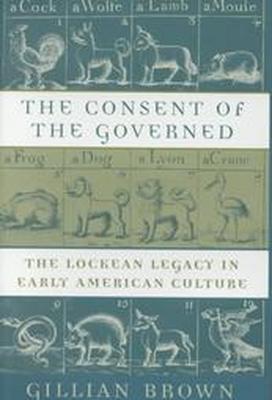
The Consent of the Governed the Lockean Legacy in Early American Culture
- Binding: Hardcover
- Publisher: Harvard Univ Pr
- Publish date: 01/01/2001
Locke linked consent with childhood, and it is his formulation of the child's natural right to consent that eighteenth-century Americans absorbed from their Lockean pedagogies and textbooks. Tracing the Lockean legacy through the New England Primer and popular readers, fables, and fairy tales, Brown demonstrates how Locke's emphasis on the liberty -- and difficulty -- of individual judgment became a received notion in the American colonies.
After the Revolution, a different prototype of individuality emerged in the American discourse on consent, in which images of seduced or misguided women replaced those of wronged children. Brown looks at two such figures, the coquette and the quixote, to reveal what they tell us about the perceived distance between conventions and the varieties of individuals whom consent can and should serve. Thus, this book suggests, the Lockean legacy to the United States is a reminder of the continual work to be done to endow every individual with consent and to make consent matter.