
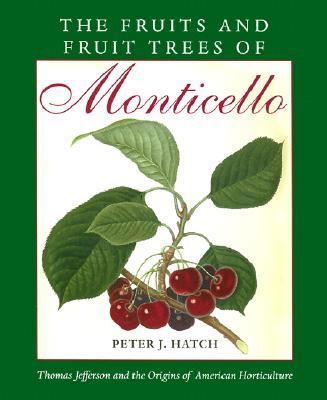
The Fruits and Fruit Trees of Monticello
- List Price: $49.50
- Binding: Hardcover
- Publisher: Univ of Virginia Pr
- Publish date: 02/01/1998
Since 1982 Jefferson's fruit plantings -- his orchards, vineyards, berry squares, and nursery -- have been gradually and painstakingly re-created at Monticello. Locating the many exotic varieties and fancy fruits has been a challenge to restorers, often forcing them to import seeds and cuttings from around the world. Several varieties, such as Jefferson's beloved Taliaferro apple, are presumed extinct, but many of his favorites -- Alpine strawberries, Albemarle Pippin apples, Green Gage plums, and Oldmixon Free peaches -- have been brought back.
Lavishly illustrated, Peter Hatch's The Fruits and Fruit Trees of Monticello is not only a detailed history of Jefferson's gardens and their re-creation but a virtual encyclopedia of early American pomology. Hatch argues that fruit growing and horticulture were in fact synonymous terms in early America, influenced primarily by the importance of alcoholic beverages to the American diet. One historian has remarked how significant it was when Americans began eating their fruit instead of drinking it.
The story of Jefferson's struggle to produce a useful and ornamental garden on a grand scale -- so carefully documented in his letters and papers -- makes for fascinating reading. His fruitery was unique in being both an Old World fruit garden and a colonial farm orchard;seedling peaches and Virginia cider apples were planted alongside French apricots, Spanish almonds, and English plums. His horticultural vision was far-reaching in scope and characteristically ahead of its time. The history of fruit growing at Monticello is a reflection of Jefferson's spirit: expansive, optimistic, epicurean, innocent, and altogether American.
| Seller | Condition | Comments | Price |
|
Calliopebooks
|
Very Good

|
$23.62
|
|
ErgodeBooks
|
Good |
$27.92
|
|
Goodwill of Greater Milwaukee
|
New |
$38.46
|
|
Bonita
|
Good
|
$44.56
|
|
ErgodeBooks
|
New |
$66.52
|
|
Bonita
|
New
|
$70.28
|
|
Just one more Chapter
|
New |
$70.91
|
|
GridFreed
|
New |
$86.47
|