
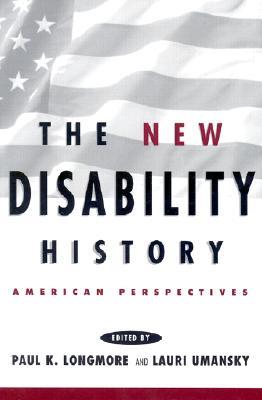
The New Disability History American Perspectives
- Binding: Paperback
- Publisher: New York Univ Pr
- Publish date: 03/01/2001
Books in the series will trace the intersections of disability with gender, race, ethnicity, and class. While some books will focus on particular disability groups, others will attempt to excavate the unspoken, unacknowledged, and often invisible ties that bind people with different disabilities together in a common history. The individual contributions and the series as a whole will bring to light the underlying common themes that bridge the apparent divisions among physical, sensory, and mental disability. Informed by the social constructionist insights and interdisciplinarity of cultural studies but firmly grounded in empirical research, the series will facilitate development of both the theory and methodology of disability history.
Disability has always been a preoccupation of American society and culture. From antebellum debates about qualification for citizenship to current controversies over access and "reasonable accommodations", disability has been present, in penumbra if not in print, on virtually every page of American history. Yet historians have only recently begun the deep excavation necessary to retrieve lives shrouded in religious, then medical, and always deep-seated cultural, misunderstanding.
This volume opens up disability's hidden history.In these pages, a North Carolina youth findshis identity as a deaf Southerner challenged in Civil War-era New York. Deaf community leaders ardently defend sign language in early 20th century America. The mythic Helen Keller and the long-forgotten American Blind People's Higher Education and General Improvement Association each struggle to shape public and private roles for blind Americans. White and black disabled World War I and II veterans contest public policies and cultural values to claim their citizenship rights. Neurasthenic Alice James and injured turn-of-the-century railroadmen grapple with the interplay of disability and gender. Progressive-era "rehabilitationists" fashion programs to make "crippled" children economically productive and socially valid, and two Depression-era fathers murder their disabled sons as public opinion blames the boys' mothers for having cherished the lads' lives. These and many other figures lead readers through hospital-schools, courtrooms, advocacy journals, and beyond to discover disability's past.
Coupling empirical evidence with the interdisciplinary tools and insights of disability studies, the book explores the complex meanings of disability as identity and cultural signifier in American history.
| Seller | Condition | Comments | Price |
|
newlegacybooks
|
Good

|
$2.80
|
|
HPB-Emerald
|
Very Good
|
$5.62
|
|
HPB-Red
|
Good
|
$5.62
|
|
Half Price Books Inc
|
Very Good
|
$11.23
|
|
ErgodeBooks
|
Good |
$14.71
|
|
True Oak Books
|
Good
|
$17.43
|
|
Bonita
|
Good
|
$33.71
|
|
TEXTSHUB
|
Good
|
$35.61
|