
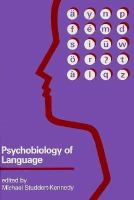
The Psychobiology of Language
- List Price: $35.00
- Binding: Hardcover
- Publisher: MIT Press
- Publish date: 12/01/2002
Description:
Derived from a Neurosciences Research Program Worksession, these original contributions focus on such questions as: What is Language? Can we distinguish language from general cognition? Is language an isolable, biologically coherent system? Does the linguistic description of language as an autonomous system, formed from a combination of more-or-less autonomous subsystems, correspond to psychological and neurophysiological fact? Together they provide a comprehensive and thoroughly up-to-date discussion of the research, knowledge, and debates in the neurobiology of language.
Contents: A Linguistic Approach (M. Liberman); A Psychological Approach (Z. W. Pylyshyn); A Neuropsychological Approach (H. Goodglass); Perceptual Processing Links to the Motor System (M. Studdert-Kennedy); Hierarchical Motor Control (J. C. Fentress); Biological Foundations of Language and of Hemispheric Dominance (N. Geschwind); Localization of Common Cortex for Motor Sequencing and Phoneme Identification (G. Ojemann); The New Lexicon: A Summary of Some Arguments Pertaining to the Nature of Lexical Representations (D. Caplan); Stages of Processing and Hemispheric Differences in Language in the Normal Subject (M. Moscovitch); On Multiple Representations of the Lexicon in the Brain: The Case of the Two Hemispheres (E. Zaidel); Naming Disorders (F. Benson); Word Retrieval for Production (H. Goodglass); Issues Regarding Laboratory Skills in Aphasia (E. B. Zurif ); Syntax as an Autonomous Component of Language (Z. W. Pylyshyn); Syntactic Processes in Sign Language (U. Bellugi); Syntactic Competence in Agrammatism: A Lexical Hypothesis (D. Caplan); Aspects of Sentence Processing in Aphasia (E. B. Zurif); Syntax in Brain-Injured Children (M. Dennis).
Michael Studdert-Kennedy is Professor in the Department of Communication at Queens College (CUNY) and is on the research staff at the Haskins Laboratories.
This book inaugurates a new series in Neuropsychology and Neurolinguistics, edited by David Caplan.
Expand description
Contents: A Linguistic Approach (M. Liberman); A Psychological Approach (Z. W. Pylyshyn); A Neuropsychological Approach (H. Goodglass); Perceptual Processing Links to the Motor System (M. Studdert-Kennedy); Hierarchical Motor Control (J. C. Fentress); Biological Foundations of Language and of Hemispheric Dominance (N. Geschwind); Localization of Common Cortex for Motor Sequencing and Phoneme Identification (G. Ojemann); The New Lexicon: A Summary of Some Arguments Pertaining to the Nature of Lexical Representations (D. Caplan); Stages of Processing and Hemispheric Differences in Language in the Normal Subject (M. Moscovitch); On Multiple Representations of the Lexicon in the Brain: The Case of the Two Hemispheres (E. Zaidel); Naming Disorders (F. Benson); Word Retrieval for Production (H. Goodglass); Issues Regarding Laboratory Skills in Aphasia (E. B. Zurif ); Syntax as an Autonomous Component of Language (Z. W. Pylyshyn); Syntactic Processes in Sign Language (U. Bellugi); Syntactic Competence in Agrammatism: A Lexical Hypothesis (D. Caplan); Aspects of Sentence Processing in Aphasia (E. B. Zurif); Syntax in Brain-Injured Children (M. Dennis).
Michael Studdert-Kennedy is Professor in the Department of Communication at Queens College (CUNY) and is on the research staff at the Haskins Laboratories.
This book inaugurates a new series in Neuropsychology and Neurolinguistics, edited by David Caplan.


Please Wait