
Error title
Some error text about your books and stuff.
Close

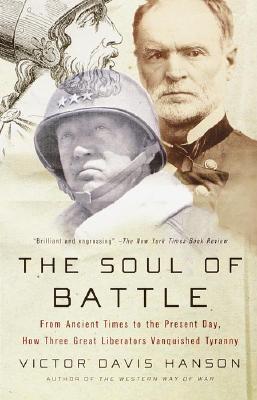
The Soul of Battle from Ancient Times to the Present Day, How Three Great Liberators Vanquished Tyranny

by Victor Davis Hanson

  • ISBN: 9780385720595
  • ISBN10: 0385720599

The Soul of Battle from Ancient Times to the Present Day, How Three Great Liberators Vanquished Tyranny

by Victor Davis Hanson

  • List Price: $18.00
  • Binding: Paperback
  • Publisher: Penguin Random House
  • Publish date: 04/01/2001
  • ISBN: 9780385720595
  • ISBN10: 0385720599
used Add to Cart $10.11
You save: 44%
Marketplace Item
Returnable at the third party seller's discretion and may come without consumable supplements like access codes, CD's, or workbooks.
new Add to Cart $14.33
You save: 20%
Marketplace Item
Returnable at the third party seller's discretion and may come without consumable supplements like access codes, CD's, or workbooks.
Description: 1. "The Dancing Floor of War" Thebes--the present-day community is built right atop the ancient--is a pleasant but little-visited Greek provincial town. No one travels to Greece to experience either ancient or modern Thebes. A pity. There are indeed certain things worth seeing there. A farmer, unconcerned about the absence of good beaches, the paucity of impressive archaeological remains, or the dearth of majestic landscape, immediately feels at home among the rolling plains of the surrounding Boeotian landscape--over 250,000 acres of rich wheat fields, row crops, olive orchards, and vineyards, a larger area even than the Attic countryside that surrounds Athens. From the Theban acropolis a keen agrarian eye notices that things grow wonderfully on this good ground--both food and people. The ancients knew that. The Theban soil, all Greeks conceded, could fuel a prosperity that would be manifested in ways other than the mere production of food. The poets Hesiod, Pindar, and Corinna were Boeotians; so was Plutarch and a host of lesser-known philosophers, artists, and politicians who inhabit the pages of Greek literature and remark on the fertility of their native ground. The Boeotian Pythagorean philosophers, Philolaus, Simmias, and Cebes, are prominent in Plato''s dialogue Phaedo, suggesting that the out-of-the-way wheat fields and vineyards of Thebes may have in fact served as a refuge for an enclave of that vanishing philosophical sect. Boeotia means "cow pastures" in Greek, but despite its ancient reputation for rusticity, this rich farmland developed a peculiar rural culture all its own, one that was always inseparable from the land. The mountains in the distance--the verdant Mts. Cithaeron and Helicon on the west flank, snow-capped Parnassus looming to the north, eastward the barren Messapion and Pton, and wooded Parnes separating Attica to the south--rise in all directions to provide good watershed. The summer heat--nearly unbearable for tourists--ensures bountiful vegetables and fruits; the soil is heavy and black in its fertility, the present-day population skilled and healthy. Water, heat, soil, and independent farmers combine to create a real agrarianism, successful enough to produce food to feed other Greeks not so fortunate, both ancient and modern. Such climate, agriculture, and terrain instantly explain the prominent place of ancient Thebes in Greek history--the site of an important Mycenaean citadel (still unexcavated beneath the modern streets and shops); the seven-gated city of myth and home to Cadmus, Herakles, Oedipus, and Antigone; and the capital city of the surrounding classical Boeotian federation. Foreigners--from the mythical Seven Against Thebes to Roman Republican generals--have always wanted this land, their megalomania usually resulting in a brutal confrontation since its tough farmers have always been just as determined not to give it up. For those Greeks in Boeotia who perished fighting the Macedonians at the battle of Chaeronea, their stark epitaph simply ended with "We died on the famed plains of Boeotia." The Greeks, we must remember, often calibrated the quality of a region''s soil by the number and nature of the infantrymen it might produce. Today in these famed but seldom visited plains, in the midst of tractors and spray rigs, there is still the stale scent of war. To the east of Thebes, less than twenty miles away, lie the rolling plains of Tanagra, Oinophyta, and Delium, sites of decisive and often glorious pitched hoplite battles against Thebes''s hated rival Athens--presently mere cotton and wheat fields covering the long-dead whose exploits are entirely unknown to the thousands who whizz by on the national freeway. How many Greeks, who have recently ripped the soil around the small resort of Delesi for the foundations of their imposing vacation homes, know that Socrates once, after the battle of Delium, bravely retreated through their backyards? To the south of Thebes about ten miles distant is the countryside of Plataea, where the grand Greek alliance of 479 destroyed the Persian army of invasion. A new road has cut right through the site and nearly ruined appreciation of the ancient town and environs--right where Theban attackers for generations tried to storm the city and likewise tear down the walls of their sometimes confederate ally. Things change and do not change on the farmland of Boeotia. On the way from Thebes to Plataea, a brief detour of a few minutes takes you to Leuctra. Out in a remote grainfield, by a small irrigation aqueduct, rises the Theban trophy of 371, a stark white marble column ringed with sculpted shields, commemorating the day Epaminondas and his Thebans demolished the Spartan elite. Not a soul will be there. Not one of the thousands of tourists who cram into Delphi each morning has visited this lonely pillar, a hallowed spot where the history of Greece was changed far more radically than by any event which occurred at that ostentatious though venerable mountain shrine thirty miles to the northwest. The killing fields of Chaeronea--where the Theban Sacred Band in 338 went down before the cavalry charge of the murderous eighteen-year-old Alexander--lie farther to the northwest in the shadow of Mt. Helicon, near the shores of the now drained Copaic basin. A proud limestone lion, erected over the remains of those illustrious 300 warriors, after twenty-three centuries still guards the old highway. Not far away are the little-visited ancient re- mains of Haliartus. There the Thebans once overwhelmed a Spartan corps and killed their maverick general Lysander, the brilliant Spartan commoner who fancied himself king. The little-known, hard-to-find battlefield of Tegyra also looms across the way from this northern plain of Boeotia. The Theban Pelopidas stopped cold a Spartan army there in 375 in what Plutarch called a "prelude to Leuctra." And Coronea--"a battle like none other of our time," the historian and eyewitness Xenophon wrote--is roughly between Chaeronea and Haliartus; in that tiny valley the Thebans slammed head-on into the phalanx of King Agesilaus and nearly killed him. Not one of these battles was brought on by the Thebans; but in nearly all of them the presence of their hoplites ensured mayhem and death for those involved. To walk the fields of Boeotia is to trample unknowingly over the bones and ashes of thousands of long-forgotten and anonymous farmers who died in their mud to keep others off of it. In a single afternoon one can drive through the farmland to nearly every major battlefield in the history of ancient Greece--Plataea, Tanagra, Oinophyta, Coronea, Delium, Haliartus, Tegyra, Leuctra, and Chaeronea. They are all in Boeotia. Mass graves, stone lions, marble columns, and funerary inscriptions dot the Boeotian landscape and fill the museums. These battles'' uncanny proximity to each other reveals the real history and character of the Boeotians. For Persian and Macedonian autocrats marching south, and for Spartan professionals pushing north, the rich plains of Boeotia always were ahead, full of tough farmers who were eager to bar the way. It is a good place to farm, and for heavy infantry an even better place to fight--and Thebes is in the very center of it all. No wonder their general Epaminondas dubbed his flat and accessible countryside "the dancing floor of war," a black-earthen land that only tough men "who kept a grip on their shield straps" could hold on to. The corpses of thousands of Spartans and Athenians in the muck of Boeotia proved that in fact they usually could. Or at least die trying. That glorious millennium of the city''s existence came to an abrupt end in September 335. Alexander the Great, the "Savior of the Greeks," simply destroyed it. Utterly. The birthplace of Herakles--the people, the buildings, the farmsteads about, everything and everybody--vanished. Gone was everything Theban in a matter of days. Alexander obliterated Epaminondas''s legacy of a democratic polis when Thebes (much of its crack infantry had been demolished or demoralized three years earlier at the Greek defeat at Chaeronea) chose not to stay in his puppet league of Greek subservient states, and instead opted for independence from Macedon on false rumors of Alexander''s demise. The agrarians of Thebes always had an unfortunate tendency to be obstinate--or rather politically inept in the baffling cosmology of shifting Greek alliance and counteralliance: fighting alongside the Persians at Plataea when the momentum had clearly swung over to the Greeks; turning on Sparta at the very conclusion of their successful joint twenty-seven-year war against Athens; parting with Alexander when the latter''s quest for Greek hegemony was nearly complete. Farmers are good fighters but poor politicians. Our ancient sources, Arrian, Plutarch, and Diodorus, agree that nearly thirty years after the Theban general Epaminondas died, Alexander butchered over 6,000 Theban men, women, and children in the streets of the city in a few hours. The rest--over 30,000 in number--were sold into slavery, the profits invested in preparations for his own upcoming march through Asia Minor to "liberate" the Greek cities from the "oppressive" Persian yoke. Arrian editorialized that the wholesale disappearance of Thebes was a novel event in Greek history--no prior disaster had instilled such horror, as the houses and walls themselves were razed, and the land parceled out to neighboring communities who had joined in the slaughter. To mask his own culpability in the genocide, Alexander, a current favorite now once again of modern encomiastic scholars, unloosed jealous Boeotian neighbors to run amuck in the city. Like present-day Serbians, Bosnians, and Croatians, a few fellow Boeotians h
Expand description
Product notice Returnable at the third party seller's discretion and may come without consumable supplements like access codes, CD's, or workbooks.
Seller Condition Comments Price  
Seller: HPB-Emerald
Location: Dallas, TX
Condition: Very Good
Shipping Icon
Connecting readers with great books since 1972! Used books may not include
[...]
Price:
$10.11
Comments:
Connecting readers with great books since 1972! Used books may not include
[...]
Seller: indoo.com
Location: Avenel, NJ
Condition: New
9780385720595.
Price:
$14.33
Comments:
9780385720595.
Seller: MI Re-Tale
Location: Dacula, GA
Condition: Like New
Size: 5x1x7; Very nice book.
Price:
$15.73
Comments:
Size: 5x1x7; Very nice book.
Seller: ErgodeBooks
Location: Houston, TX
Condition: Good
Trade paperback (US). Glued binding. 496 p. Contains: Illustrations.
Price:
$23.50
Comments:
Trade paperback (US). Glued binding. 496 p. Contains: Illustrations.
Seller: ErgodeBooks
Location: Houston, TX
Condition: New
Trade paperback (US). Glued binding. 496 p. Contains: Illustrations.
Price:
$30.40
Comments:
Trade paperback (US). Glued binding. 496 p. Contains: Illustrations.
Seller: Just one more Chapter
Location: Miramar, FL
Condition: New
Price:
$37.51
Comments:
Seller: Bonita
Location: Santa Clarita, CA
Condition: Good
Shipping Icon
Access codes and supplements are not guaranteed with used items. May be an ex-library book.
Price:
$38.18
Comments:
Access codes and supplements are not guaranteed with used items. May be an ex-library book.
Seller: Bonita
Location: Santa Clarita, CA
Condition: New
Shipping Icon
Price:
$64.82
Comments:
Seller: GridFreed
Location: San Diego, CA
Condition: New
Size: 84x16x126; In shrink wrap. Looks like an interesting title!
Price:
$110.81
Comments:
Size: 84x16x126; In shrink wrap. Looks like an interesting title!
please wait
Please Wait

Notify Me When Available

Enter your email address below,
and we'll contact you when your school adds course materials for
.
Enter your email address below, and we'll contact you when is back in stock (ISBN: ).