
Error title
Some error text about your books and stuff.
Close

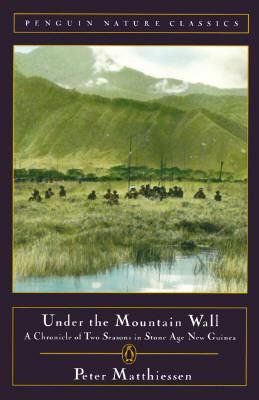
Under the Mountain Wall a Chronicle of Two Seasons in Stone Age New Guinea

by Peter Matthiessen

  • ISBN: 9780140252705
  • ISBN10: 0140252703

Under the Mountain Wall a Chronicle of Two Seasons in Stone Age New Guinea

by Peter Matthiessen

  • List Price: $19.00
  • Binding: Paperback
  • Publisher: Penguin USA
  • Publish date: 06/01/1996
  • ISBN: 9780140252705
  • ISBN10: 0140252703
used Add to Cart $5.27
You save: 72%
Marketplace Item
Returnable at the third party seller's discretion and may come without consumable supplements like access codes, CD's, or workbooks.
new Add to Cart $13.16
You save: 31%
FREE shipping on orders over $79!
You save: 56%
Product Notice
Not returnable and may come without consumable supplements like access codes, CD's, or workbooks.
ebook Buy $4.99
License: lifetime
License Details
You are licensing a digital product for a set duration. Durations are set forth in the product description, with "Lifetime" typically meaning five (5) years of online access and permanent download to a supported device. All licenses are non-transferrable. More details can be found here. May come without consumable supplements like access codes, CD's, or workbooks.
Description: Peter Matthiessen (1927-2014) is the only writer who has ever won the National Book Award in both fiction and nonfiction. His travels as a naturalist and explorer have resulted in more than a dozen books on natural history and the environment, including The Snow Leop ard, his first NBA winner. Matthiessen''s equally important career in fiction has produced a collection of stories and nine novels, among them At Play in the Fields of the L ord (an NBA finalist) and the Everglades trilogy ( Killing Mister Wat son, Lost Man''s Ri ver, and Bone by B one), which, rewritten and distilled, were published in one volume in 2008 under the title Shadow Coun try, winner of the NBA in fiction. Shadow Coun try was also the 2010 recipient of the William Dean Howells Medal, given by the American Academy of Arts and Letters for the most distinguished American novel published during the previous five years. Matthiessen was a member of the American Academy of Arts and Letters. His final novel, In Parad ise, was published just after his death in 2014. UNDER THE MOUNTAIN WALL A chronicle of two seasons in Stone Age New Guinea PETER MATTHIESSEN PENGUIN NATURE CLASSICS Nature is our widest home. It includes the oceans that provide our rain, the trees that give us air to breathe, the ancestral habitats we shared with countless kinds of animals that now exist only by our sufferance or under our heel. Until quite recently, indeed (as such things go), the whole world was a wilderness in which mankind lived as cannily as deer, overmastering with spears or snares even their woodsmanship and that of other creatures, finding a path wherever wildlife could go. Nature was the central theater of life for everybody''s ancestors, not a hideaway where people went to rest and recharge after a hard stint in an urban or suburban arena. Many of us still do hike, swim, fish, birdwatch, sleep on the ground or paddle a boat on vacation, and will loll like a lizard in the sun any other chance we have. We can''t help grinning for at least a moment at the sight of surf, or sunlight on a river meadow, as if remembering in our mind''s eye paleolithic pleasures in a home before memories officially began. It is a thoughtless grin because nature predates "thought." Aristotle was a naturalist, and nearer to our own time, Darwin made of the close observation of bits of nature a lever to examine life in many ways on a large scale. Yet nature writing, despite its basis in science, usually rings with rhapsody as well--a belief that nature is an expression of God. In this series we are presenting some nature writers of the past century or so, though leaving out great novelists like Turgenev, Melville, Conrad, and Faulkner, who were masters of natural description, and poets, beginning with Homer (who was perhaps the first nature writer, once his words had been transcribed). Nature writing now combines rhapsody with science and connects science with rhapsody, and for that reason it is a very special and a nourishing genre. Edward Hoagland Preface The peaks of the Snow Mountains, on bright mornings, part the dense clouds and soar into the skies of Oceania. Beneath the clouds, like a world submerged, lie the dark rocks which form the great island of New Guinea; climbing abruptly from the Dampier Strait in the East Indies, the range extends eastward fifteen hundred miles until, at land''s end in Papua, it sinks once more beneath the ocean. The Snow Mountains are the summit of western New Guinea. On a high flank in the central highlands lies a sudden valley: here the Baliem River, which had vanished underground some twenty miles upstream, bursts from the mountain wall onto a great green plain. The plain itself, ten miles across, is a mile above the sea. Fifty miles southeast of the valley''s head, the river drops into a gorge and passes from the mountains, to subside at last in the vast marshes of sun and mud and sago palms stretching southward to the Arafura Sea. The Baliem Valley was discovered from the air in 1938, but no white man came to live there until 1954, when a government post was established on abandoned lands of the Wukahupi tribes. Dutch patrols have now explored much of the valley, which supports more than forty thousand people, and the last large blank on the most recent maps is a region of perhaps thirty square miles under the northeast wall. This remote corner is controlled by those tribes of the Ndani or Dani-speaking peoples known as the Kurelu; the Dani language, with small tribal variations, is spoken throughout the valley and beyond, yet it is but one of many distinct languages in the central highlands. (The origins of these languages, like the origins of the people themselves, are virtually unknown. One may suppose that the mountain Papuans came out from Asia long before the Polynesians--though in the wake of the Australian aborigines--and that they were forced into the mountains by peoples who came after, but the near absence of archaelogical evidence makes any attempt at chronology unintelligent.) The region is bordered in the south by the Aike River and in the west, toward the Baliem, by the lands of the enemy Wittaia. In the north and east it ends abruptly at the mountain wall. The wall rises in a series of steep ridges to an outer rim which varies, around the valley, from ten to twelve thousand feet in elevation; the upper wall is rarely seen. All day, all year, the clouds balance on the rim, as if about to tumble in. They are dark and still and all but permanent, protecting the great valley from infecting winds. The Kurelu are named for the tribal kain or leader: their country, that is, is "Kurelu''s Land." The tribe is divided into four main groups: the Loro-Mabell to the northward, the Kosi-Alua from the western grasslands, the Haiman-Halluk, between the Kosi-Alua and the mountains, and the Wilihiman-Walalua, in the south. The Wilihiman-Walalua is the people''s contraction of four clan names (Wilil:Haiman-Walilo:Alua) and represents, politically, a union of allied villages. Several such unions, linked by clan or more or less well disposed toward one another, may form a loose confederacy and are led by the most powerful kain--in this case, Kurelu, kain of the Loro-Mabell. Their boundaries are fluid and informal, dependent on the predominance of clan, though the clans are spread throughout the villages. The clan Alua, for example, is well represented not only in the Wilihiman-Walalua but in the Kosi-Alua. The latter groups share a common frontier with the enemy and may be called the southern Kurelu. Because the southern Kurelu were entirely untouched by civilization, their culture was chosen for study by the Harvard-Peabody Expedition of 1961. The expedition, sponsored in part by the government of the Netherlands, entered the Baliem at the end of March and remained until September, with the cooperation and assistance of the Dutch officials, particularly Dr. Victor de Bruyn of the Office of Native Affairs. Its purpose was to live among the people as unobtrusively as possible and to film and record their wars, rituals, and daily life with a minimum of interference, in order that a true picture of a Stone Age culture--one of the few in which both war and agriculture are important--might be preserved. This book is a chronicle of two seasons in the Stone Age. The few details and episodes not actually witnessed by the author were supplied and confirmed by other members of the party--Robert Gardner, cameraman and leader of the expedition whose film, Dead Birds , concerns the Kurelu; Karl G. Heider, anthropologist; Jan Broekhuyse, anthropologist; Michael Rockefeller, photographer and sound technician. The expedition was joined by photographer Eliot Elisofon for the month of May; by botanist Chris Versteegh for two weeks in June; and by medical student Samuel Putnam in July and August; it was assisted immeasurably by the talents and good company of its Dani interpreter, Abututi, with his wife, Wamoko, and of its cook, Yusip. All of these have made important contributions to this book, but I am particularly indebted to Jan Broekhuyse, whose, year of prior experience with other Baliem tribes proved invaluable in the gathering and assessment of information, and to Karl Heider, who remained with the Kurelu after the departure of the expedition and has since supplied extensive data and corrections. Heider, Broekhuyse, and Gardner have been kind enough to inspect the manuscript for errors and distortions, and within the limits of our present understanding of the culture an honest portrait of the Kurelu has been attempted. This is the story of the great warrior Weaklekek and of the swineherd Tukum, of U-mue and his family, and of their enemies and friends. The events described were observed to have happened to these tribesmen, called by these names, in the spring and summer of 1961--though occasionally, minor actions of one person have been attributed to another, to avoid a confusing multiplicity of characters. The glossary in the back of the book will serve as a key to the dramatis personae as well as to pronunciation. Reference to the tribe''s exposure to the expedition has been omitted, not only because the first reactions of a wild people to the white man, affecting and sad and funny though they are, have been well documented, but because the Kurelu offered a unique chance, perhaps the last, to describe a lost culture in the terrible beauty of its pure estate. The armed patrols and missionaries invaded their land on the heels of the expedition, and by the time this account of them is published, the proud and warlike Kurelu will be no more than another backward people, crouched in the long shadow o
Expand description
Product notice Returnable at the third party seller's discretion and may come without consumable supplements like access codes, CD's, or workbooks.
Seller Condition Comments Price  
Seller: Blue Vase Books
Location: Interlochen, MI
Condition: Good
Shipping Icon
The item shows wear from consistent use but it remains in good condition and
[...]
Price:
$5.27
Comments:
The item shows wear from consistent use but it remains in good condition and
[...]
please wait
Please Wait

Notify Me When Available

Enter your email address below,
and we'll contact you when your school adds course materials for
.
Enter your email address below, and we'll contact you when is back in stock (ISBN: ).