
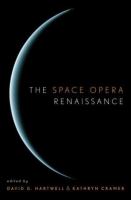
The Space Opera Renaissance
- Publisher: Doherty Associates, LLC, Tom
- Publish date: 07/10/2007
Description:
THE SPACE OPERA RENAISSANCE I. REDEFINED WRITERS Chubby, brownette Eunice Kinnison sat in a rocker, reading the Sunday papers and listening to the radio. Her husband Ralph lay sprawled upon the davenport, smoking a cigarette and reading the current issue of EXTRAORDINARY STORIES against an unheard background of music. Mentally, he was far from Tellus, flitting in his super-dreadnaught through parsec after parsec of vacuous space. --E. E. "Doc" Smith, Ph.D., Triplanetary, Chapter 5: "1941" EDMOND HAMILTON Edmond Hamilton [1904-1977] (tribute page: www.pulpgen.com/pulp/edmond_hamilton) was the great original writer of space opera in science fiction. Jack Williamson says: "With his tales of the Interstellar Patrol, beginning with ''Crashing Suns'' (1928), he was arguably the inventor of space opera. Long on future progress, if a bit short on hard science, he imagined a vast interstellar civilization, always in danger of some cosmic catastrophe to be averted at the last instant by his little band of human and alien heroes." Hamilton was born in Youngstown, Ohio, and lived with his parents across the state line in New Castle, Pennsylvania, until the 1940s, when he married Leigh Brackett. He said in an interview with Patrick Nielsen Hayden, in 1975 (www.pulp-gen.com/pulp/edmond_hamilton/twibbet_interview.html), that he was profoundly influenced as a young man in the teens and early twenties by the pulp SF of Homer Eon Elint. "He''d write stories about moving the Earth to Jupiter and things like that. And those fired my imagination. I''ve always been glad to say, I owe this and that to Mr. Flint." He sold his first story to Weird Tales in 1925, and his next forty stories thereafter. Most of them were science fiction, which Weird Tales (since the term "science fiction" was not coined until 1930) called "weird-scientific" tales. By the early 1930s he was one of the giants of science fiction. He was the first genre writer to conceive of interstellar flight ("I think so. On a wide scale, anyway. One thing I''ve found out, over the years, is that, anytime you think that you were the originator of some new idea, ''I was the first to do that,'' you''ll find some old fellow who did it back around 1895. Every darn time."--PNH interview), and also the first to write of friendly aliens ("Yes ... I think I was, in one sense. I began that in 1932, with a story called ''Renegade.'' It was published under the title of ''Conquest of Two Worlds.'' They thought the title wasn''t science-fictional enough ... . But it seemed to me wrong to always make the Earthman in the right. Let''s show him up to be something different."--PNH interview). It is one of the sad ironies of literary history that his work is nearly forgotten today, while the work of his contemporary, E. E. "Doc" Smith, Ph.D., who died in the 1960s, although in some ways inferior to Hamilton''s, is still popular and in print. His best friend, Jack Williamson, is still alive and writing SF and space opera in his nineties. Williamson says: Hamilton''s skills were perfectly tuned for the pulps ... his stories moved fast. He wrote them fast, commonly sending them out in first draft. He was prolific, his space operas earning him a reputation as "World-Wrecker" or "World-Saver" Hamilton. ... He wrote nearly all the short novels for Captain Future, which was published quarterly from 1940 through 1944. They were the purest sort of pulp, tailored to fit a formula devised by Mort Weisinger, his editor at the "Thrilling" group. Besides the captain himself, the characters were a robot, an android, and a brain in a box. The pattern dictated everything, even the paragraphs in which the characters were introduced and the order of events in the opening chapter. ... World War II changed everything. The old pulp markets disappeared. Though Ed was able to adapt when he tried, with such fine stories as "He That Hath Wings," he spent most of the next twenty years as one of the top script writers for the Superman and Batman comics. (all three quotes from "Edmond Hamilton: As I Knew Him" by Jack Williamson) Hamilton also says in the PNH interview that he (and his wife also) declined to submit stories to John W. Campbell after he became editor at Astounding, because it cost too much in time to rewrite and revise to Campbell''s edits. "I never sent him a story again. Reason being: I could not make a living writing for John Campbell. And he didn''t like his writers ... to write for other magazines." Unfortunately this is the career of a good writer who developed a successful repository of techniques and a set of professional attitudes in the pulp era and never changed them entirely, even after the era ended. It is easy to assume with historical hindsight that Wilson Tucker in his fanzine in 1941--when Hamilton was hacking out Captain Future pulp novellas for a living--did not have Hamilton''s early work in mind when he defined space opera as "filthy, stinking hackwork." But on the other hand it may plausibly have seemed that the former great was going downhill at the same time that Smith and Williamson were selling to Campbell at higher rates, with more ambitious material. Gary Westphal (who assumes that "space opera" is a term of approval) makes that case in his essay on space opera in The Cambridge Companion to Science Fiction : Despite the accomplishments of Smith and contemporaries like Campbell, Williamson, Ray Cummings, and Clifford D. Simak, the most prolific and prominent writer of classic space operas was Edmond Hamilton. Particularly fond of stories involving planets being threatened or blown to pieces, Hamilton earned the epithets "World-Saver" and "World-Wrecker," and the reference to "world-saving" in Tucker''s definition suggests that Hamilton might have been the principal target of his approbation [sic--ed.]. Yet Hamilton proved capable of producing more subdued, even wistful, varieties of space opera, like "The Dead Planet" (1946), where a group of explorers hear the holographic testimony of a long-dead alien civilization that sacrificed itself to save the galaxy from virulent energy-beings; finally, we learn the aliens were in fact the human race. Hamilton also crafted the first space opera franchise, Captain Future, a magazine said to prefigure Star Trek in describing the recurring exploits of a spaceship captain and his crew--a robot, an android, and a disembodied brain. But we think it is not necessarily the case. Nor did Hamilton: "In a 1977 interview given just before his death, Edmond Hamilton, one of the founders of the subgenre, was still able to say, ''Bob Tucker invented that term when he was a fan, and I was reproaching him last spring again for having done so. I''m an old space opera fan; I don''t like to see it mocked.''" (Quoted in David Pringle''s essay "What Is This Thing Called Space Opera?") We think that the pejorative term was aimed at the much less capable imitators of the patterns of world-saving and warring interstellar fleets originated by Hamilton, then prevalent in the lesser pulp magazines such as Amazing Stories in the early 1940s. But it is also very likely that as the years passed and the term became more widely used, it became easy to assume that Hamilton and Smith and Williamson were the original targets of opprobrium. After Hamilton married Brackett, and after he became a successful script writer for comic books--in those days considered a form lacking in any aesthetic value, lower class than the pulps (and at about the same time that Alfred Bester gave up writing for comics)--he did produce more ambitious work from time to time, since the pressure of paying the bills was less and the time to revise and rewrite available. He continued to publish new material into the 1970s, but was not regarded as having kept up with the genre. His collection The Best of Edmond Hamilton (1977) is a worthwhile sampling of his short fiction, most of it from before 1939. The first volumes of a new set of Hamilton story collections appeared in 1999 and 2002, and athird, collecting his early SF, has been announced, so the new fashion for space opera may be doing his posthumous reputation some good. His work deserves reassessment. He should be remembered for his best, not his average. "The Star Stealers" is from the very beginning of his career and from near the very beginning of genre science fiction. It was first published in Weird Tales in February 1929. One can see how both comics and TV space opera ( Star Trek, in particular) and later movies such as the Star Wars films were influenced by this strain of adventure SF. It was all there in 1929, fast-paced, large-scale, a bit clunky and absurd, and filled with images of wonder. There are many crudities, but one can easily apprehend how this fiction moved in the estimation of generations of SF readers from astonishing cutting-edge SF to trash to pulp nostalgia over the decades. THE STAR STEALERS EDMOND HAMILTON 1 As I stepped into the narrow bridgeroom the pilot at the controls there turned toward me, saluting. "Alpha Centauri dead ahead, sir," he reported. "Turn thirty degrees outward," I told him, "and throttle down to eighty light-speeds until we''ve passed the star." Instantly the shining levers flicked back under his hands, and as I stepped over to his side I saw the arrows of the speed-dials creeping backward with the slowing of our flight. Then, gazing through the broad windows which formed the room''s front si
Expand description
Product notice
Returnable at the third party seller's discretion and may come without consumable supplements like access codes, CD's, or workbooks.
| Seller | Condition | Comments | Price |
|
Goodwill Books
|
Good

|
$4.72
|
|
Bookmans
|
Good
|
$5.85
|
|
HPB Inc.
|
Very Good
|
$8.98
|
|
Bonita
|
Good
|
$39.31
|
|
Just one more Chapter
|
New |
$73.12
|
|
Bonita
|
New
|
$137.02
|

Please Wait