
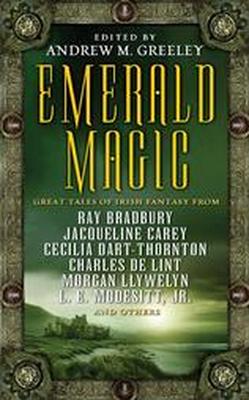
Emerald Magic Great Tales of Irish Fantasy
- Binding: Paperback
- Publisher: Tor Books
- Publish date: 02/01/2005
Description:
Herself By Diane Duane I met the leprechaun for the first and last time in the conveyor-sushi bar behind Brown Thomas. It was the "holy hour," between three and four, when the chefs go upstairs for their own lunch, and everything goes quiet, and the brushed stainless-steel conveyor gets barer and barer. The leprechaun had been smart and ordered his yasai-kakiage just before three. He sat there now eating it with a morose expression, drinking sake and looking out the picture windows facing on Clarendon Street at the pale daylight that slid down between the high buildings on either side. While I''d seen any number of leprechauns in the street since I moved here--our family always had the Sight--I''d never found myself so close to one. I would have loved to talk to him, but just because you can see the Old People is no automatic guarantee of intimacy: they''re jealous of their privacy, and can be more than just rude if they felt you were intruding. I weighed a number of possible opening lines, discarded them all, and finally said, "Can I borrow your soy sauce? I''ve run out." He handed me the little square pitcher in front of his place setting and picked up another piece of yasai-kakiage. I poured shoyu into the little saucer they give you, mixed some green wasabi horseradish with it, and dunked in a piece of tuna sashimi. "You''re not supposed to do that," he said. "Sorry?" "Mix them like that." He gestured with his chin at the wasabi. "You''re supposed to just take it separately." I nodded. "I''m a philistine," I said. "So are we all these days," the leprechaun said, and looked even more morose. He signaled the obi-clad waitress, as she passed, for another sake. "Precious little culture left in this town anymore. Nothing but money, and people scrabbling for it." It would hardly have been the first time I''d heard that sentiment coming from a Dubliner, but it hadn''t occurred to me that one of the Old People thought the same way. I''d have thought they were above such things. "Do you work in town?" I said. He nodded. The waitress came back, swapped him a full flask of sake for his empty one, left again. "Shoes?" I said. He laughed, a brief bitter crack of a sound. "Have you ever tried to cobble a Nike?" he said. I shook my head. It wasn''t something I''d had to try lately, though I''d had enough job worries of my own. The Dublin journalistic grind is not a simple one to navigate. I had gone from features editor to subfeatures editor at one of the CityWatch magazines, always being hurled from scandal to scandal--they would keep publishing badly concealed ads for the less discreet of the massage parlors and lap-dancing joints over by Leeson Street. "That line of work''s all done now," he said. "Planned obsolescence...it runs straight to the heart of things. People don''t want shoes that last years. They want shoes that maybe last a year. My folk, we couldn''t do that. Against our religion." I didn''t say anything, not knowing if it would be wise. I did some interviewing for the magazine I worked for, and had learned to appreciate the sound of a subject that the speaker didn''t want you to follow up on. "It''s the death of craftsmanship," the leprechaun said. "Nike and all the other big conglomerates, they''d sooner have slave labor in Malaysia than honest supernatural assistance from a first-world country with good tax breaks..." He drank some sake. "No, we''re all in information technology now, or high-end manufacturing, computers and so on. It''s the only place left for skilled handworkers to go. My clan was all out in Galway once: they''re all in Fingal now, for the work. Damn made-up county, nothing real about it but freeways and housing developments. Name me a single hero-feat that was ever done in Fingal!" "I got from Independent Pizza to the airport once in less than half an hour," I said: and it was all I could think of. It didn''t count, and we both knew it. All the same, he laughed. It broke the ice. We were there for a few hours at least, chatting. The belt started up again while we talked, and some more people drifted in; and still we talked while the light outside faded through twilight to sodium-vapor streetlight after sunset. The leprechaun turned out not to be one of those more-culchie-than-thou types, all peat and poitín, but an urbanite--clued-in and streetwise, but also well-read. He knew where the hot clubs were, but he could also quote Schopenhauer as readily as he could Seamus Heaney; and as for culture, he told me several things about Luciano Pavarotti''s last visit to Dublin that made me blink. He was, in short, yet another of that classic type, the genuine Dublin character. When you live here, it''s hard to go more than a few days before meeting one. But you don''t routinely meet "Dublin characters" who saw the Vikings land. I ordered more sake, and paused. Slipping into a seat around the corner of the sushi bar from us was someone at first sight more faerie-tale-looking than the leprechaun: a baby teen, maybe thirteen if that, in red velvet hooded sweatshirt and fake wolf-claw wristlet. Little Red Riding Hood squirmed her blue-jeaned, tanga-briefed self in the seat as she began picking at some fried tofu. The leprechaun glanced at her, glanced back at me again, the look extremely ironic. By contrast, he was conservatism itself, just a short guy with hair you''d mistake for sixties length, in tweeds and extremely well made shoes. "She''d have been a nice morsel for one of the Greys in my day," he said under his breath, and laughed again, not entirely a pleasant sound. "Before the wolfhounds did for them, and ''turncoat'' men ran with the wolf packs, getting off on the beast-mind and the blood feast... Just look at all that puppy fat." His grin was feral. "But I shouldn''t complain. She pays my salary. I bet her daddy and mammy buy her a new computer every year." He scowled. "Do you really miss the shoes that much?" I said. It was a mistake. His eyes blazed as he took a plate of the spiced soba noodles, another of the green plates, the least expensive sushi. He didn''t have a single blue or gold or silver plate in his "used" stack. "Don''t get me started," he said. "Nike, Adidas, whoever: we would have worked with them. We would have worked with them ! Work is what we live f good work, well-done, they could have had a labor force like the world never saw. We could have shod the planet ." The leprechaun chewed. "But no," he said. "A decent wage was too much for them. Why should we pay you minimum wage, they say, when we can get the work for almost nothing from these poor starving mortals over in Indonesia or wherever, who''re grateful for a penny a day? And so they gave us their back." He poured himself more sake, drank. "We were to be here for you, from the beginning of things," he said more softly; "we were to help you have the things you needed when you couldn''t have them otherwise. But your people have made us redundant. Spiritually redundant as well as fiscally. So now, as we can''t earn, neither can we spend. ''And who of late,'' he said sadly into his sake, ''for cleanliness, finds sixpence in her shoe?''" "Bad times," I said, looking past the Mercedes and the BMWs and the ladies walking past the sushi bar toward the "signature" restaurants farther down the road, where you couldn''t get out the door at the end of the night for less than three hundred Euro for just a couple of you and wine. "Bad times," the leprechaun said. "And it''s hard to find a decent pint," I said. His eyes glittered, and I kept my smile to myself. Any Dubliner is glad to tell a stranger, or somebody with my Manhattan accent, where the best pint is. Sometimes they''re even right. Sometimes it''s even someplace I haven''t already heard of. I don''t drink the Black Stuff myself, especially since there''s better stout to be found than Uncle Arthur''s overchilled product in the Porter House brewpub in Parliament Street; but that''s not the point. His eyes slid sideways to betray the great secret, whose betrayal is always joy. "You know South Great Georges Street?" "Yeah." It was a few blocks away. "The Long Hall," he said. "Good place. The wizards drink there, too." "Really," I said. "That''s where most of us go now." There was a silent capital on the "u" that I nodded at. "We go down there Tuesdays and Thursdays, in the back, for a pint. And the wakes," he said. His look went dark. "A lot of wakes lately..." "Suicide?" I said softly. Irish males have had a fairly high suicide level of late, something no one understands with the economy booming the way it''s been, and somehow I wouldn''t have been surprised to find the trend had spread to the Old Ones. He shook his head. "Nothing like," the leprechaun said. "None of these people were suicidal. They had good jobs...as good as jobs get for our people these days. Coding over at Lotus, hardware wrangling up at Gateway and Dell. They never seem to stop hiring up there in the Wasteland." It was a slang name for the jungle of industrial estates that had sprung up around Dublin Airport, and there seemed to be a new one every month, more and more land once full of Guinness-destined barley, or of sheep, now full of Europe-destined PCs and other assorted chippery. "But it''s not the same," I said, because I knew what was coming. I''d heard it before. "No, it''s not," the leprechaun said with force. "Once upon a time I didn''t even know what the ISEQ was! When did our people ever have to worry about stocks and shares, and ''selling short''? But now we have to, because that''s how you tell who''s hiring, when you can''t make a living making shoe
Expand description
Product notice
Returnable at the third party seller's discretion and may come without consumable supplements like access codes, CD's, or workbooks.
| Seller | Condition | Comments | Price |
|
HPB-Diamond
|
Very Good

|
$4.42
|
|
HPB Inc.
|
Very Good
|
$4.42
|
|
Blue Vase Books
|
Good
|
$4.42
|
|
Firefly Bookstore
|
Good
|
$5.62
|
|
Archives Books, inc.
|
Very Good
|
$6.50
|
|
Basement Seller 101
|
Like New
|
$17.33
|
|
Bonita
|
Good
|
$33.36
|
|
Just one more Chapter
|
New |
$65.72
|
|
GridFreed
|
New |
$115.75
|

Please Wait