
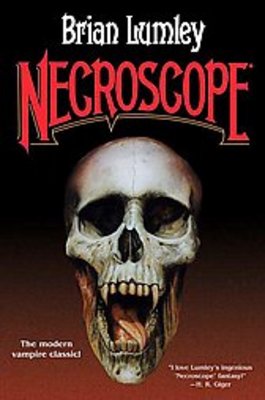
Necroscope Invaders
- Publisher: Tor Books
- Publish date: 09/01/2009
Description:
NECROSCOPE CHAPTER ONE Moscow, May 1971 C entral in a densely wooded tract of land not far out of the city--where the Serpukhov road passed through a saddle between low hills and gazed for a moment across the tops of close-grown pines towards Podolsk, which showed as a hazy smudge on the southern horizon, brightly pricked here and there with the first lights of evening--stood a house or mansion of debased heritage and mixed architectural antecedents. Several of its wings were of modern brick upon old stone foundations, while others were of cheap breeze blocks roughly painted over in green and grey, almost as if to camouflage their ill-matching construction. Bedded at their bases in steeply gabled end walls, twin towers or minarets decayed as rotten fangs and gaunt as watchtowers--whose sagging buttresses and parapets and flaking spiral decorations detracted nothing from a sense of dereliction--raised broken bulbous domes high over the tallest trees, their boarded windows glooming like hooded eyes. The layout of the outbuildings, many of which had been recently re-roofed with modern red brick tiles, might well suggest a farm or farming community, though no crops, farm animals or machines were anywhere in evidence. The high all-encompassing perimeter wall--which from its massy structure, reinforced abutments and broad breast walls might likewise be a relic of feudal times--showed similar signs of recent repair work, where heavy grey concrete blocks had replaced crumbling stone and ancient brick. To east and west where streams ran deep and gurgling over black, rounded rocks, flowing between steep banks which formed them into natural moats, old stone bridges supporting lead roofs green with moss and age tunnelled into and through the walls, their dark mouths muzzled with steel-latticed gates. All in all grim and foreboding. As if the merest glimpse of the place from the highway would not be sufficient warning in itself, a sign at the T-junction where a cobbled track wound away from the road and into the woods declared that thisentire area was "Property of the State," patrolled and protected, and that all trespassers would be prosecuted. Motorists were not permitted to stop under any circumstances; walking in the woods was strictly forbidden; hunting and fishing likewise. Penalties would be, without exception, severe. But for all that the place seemed deserted and lost in its own miasma of desolation, as evening grew into night and a mist came up from the streams to turn the ground to milk, so lights flickered into life behind the curtained ground-floor windows, telling a different story. In the woods, on the approach roads to the covered bridges, large black saloon cars might also appear abandoned where they blocked the way--except for the dull orange glowing of hot cigarette tips within, and the smoke curling from partly wound-down windows. It was the same inside the grounds: squat, silent shapes which might just represent men, standing in the shadowed places, their dark grey overcoats as like as uniforms, faces hidden under the brims of felt hats, shoulders robotically square ... . In an inner courtyard of the main building, an ambulance--our maybe a hearse--stood with its back doors open, white-overalled attendants waiting and the driver seated uncomfortably at the high steering-wheel. One of the attendants played with a steel loading roller, spinning it on well-lubricated bearings at the rear end of the long, somehow sinister vehicle. Nearby, in an open-ended barnlike structure with a sagging canvas roof, a helicopter''s dull paintwork and square glass windows gleamed darkly in shadow, its fuselage bearing the insignia of the Supreme Soviet. In one of the towers, leaning carefully on a low parapet wall, a figure with Army night-sight binoculars scanned the land about, particularly the open area between the perimeter wall and the central cluster. Projecting above his shoulder, the ugly blue metal snout of a high-calibre machine gun was limned faintly against a horizon growing steadily darker. Inside the main building, modern soundproof partition walls now divided what had once been a vast hall into fairly large rooms, serviced by a central corridor lit with a row of fluorescent tubes strung along a high ceiling. Each room had a padlocked door and all the doors were fitted with tiny grille windows with sliding covers on the inside, and with small red lights which, when blinking, signified "No Entry--Not to be Disturbed." One of these lights, halfway down the corridor on the left, was blinking even now. Leaning against the wall to one side of the door with the blinking light, a tall, hard-faced KGB operative cradled a submachine-gun in his arms. For the moment relaxed, he was ready tospring to attention--or into action--at a moment''s notice. The merest hint of the door opening, the sudden cessation of the red light''s blinking, and he would snap up straighter than a lamppost. For while none of the men in that room was his real master, nevertheless one of them was as powerful as anyone in the highest ranks of the KGB, perhaps one of the ten most powerful men in Russia. There were other men in the room beyond the door, which in fact was not one room but two, with an interconnecting door of their own. In the smaller room, three men sat in armchairs, smoking, their hooded eyes fixed on the partition wall, of which a large central section, floor to ceiling, was a one-way viewscreen. The floor was carpeted; a small wheeled table within easy reach supported an ashtray, glasses, and a bottle of slivovitz; all was silent except for the breathing of the three and the faint electric whirr of the air-conditioning. Subdued lighting in a false ceiling was soothing to their eyes. The man in the middle was in his mid-sixties, those to right and left perhaps fifteen years younger. His proteges, each of them knew the other for a rival. The man in the middle knew it, too. He had planned it that way. It was called survival of the fittest; only one of them would survive to take his place, when eventually that day came. By then the other would have been removed--perhaps politically, but more likely in some other, still more devious fashion. The years between would be their proving ground. Yes, survival of the fittest. Completely grey at the temples, but with a broad contrasting central stripe of jet-black hair swept back from his high, much-wrinkled brow, the senior man sipped his brandy, motioned with his cigarette. The man on his left passed the ashtray; half of the hot ash found its target, the rest fell to the floor. In a moment or two the carpet began to smoulder and a curl of acrid smoke rose up. The flanking men sat still, deliberately ignoring the burning. They knew how the older man hated fussers and fidgets. But at last their boss sniffed, glanced down at the floor from beneath bushy black eyebrows, ground his shoe into the carpet, to and fro, until the smouldering patch was extinguished. Beyond the screen, preparations of a sort had been in progress. In the Western World it might be said that a man had been "psyching himself up." His method had been simple ...startlingly simple in the light of what was about to occur; he had cleansed himself. He had stripped naked and bathed, minutely and laboriously soaping and scrubbing every square inch of his body. He had shaved himself, removing all surface hair from his person with the exception of the close-cropped hair of his head. He had defecated before and after his bath, on the secondoccasion doubly ensuring his cleanliness by washing his parts again in hot water and towelling himself dry. And then, still completely naked, he had rested. His method of resting would have seemed macabre in the extreme to anyone not in the know, but it was all part of the preparations. He had gone to sit beside the second occupant of the room where he lay upon a not quite horizontal table or trolley with a fluted aluminium surface, and had lain his head on his folded arms where he rested them upon the other''s abdomen. Then he had closed his eyes and, apparently, had slept for some fifteen minutes. There was nothing erotic in it, nothing remotely homosexual. The man on the trolley was also naked, much older than the first, flabby, wrinkled, and bald but for a fringe of grey hair at his temples. He was also very dead; but even in death his pallid, puffy face, thin mouth and dense grey inward-slanting eyebrows were cruel. All of this the three on the other side of the screen had watched, and all had been accomplished with a sort of clinical detachment and no outward indication of awareness from the--performer?--that they were there at all. He had simply "forgotten" their presence; his work was all-engrossing, too important to admit of outside agencies or interferences. But now he stirred, lifted his head, blinked his eyes twice and slowly stood up. All was now in order; the inquiry could commence. The three watchers leaned forward a little in their armchairs, automatically controlled their breathing, centred all their attention on the naked man. It was as if they feared to disturb something, and this despite the fact that their observation cell was completely insulated, soundproof as a vacuum. Now the naked man turned the trolley carrying the corpse until its lower end, where the clay-cold feet projected a little way and made a "V," overhung the lip of the bath. He drew forward a second, more conventional trolley-table and opened the leather case which lay upon it, displaying scalpels, scissors, saws--a whole range of razor-sharp surgical instruments. In the observation cell, the man in the centre allowed himself a
Expand description
Product notice
Returnable at the third party seller's discretion and may come without consumable supplements like access codes, CD's, or workbooks.
| Seller | Condition | Comments | Price |
|
Gate City Books
|
Good |
$48.28
|
|
3brothers Bookstore
|
Good |
$49.25
|
|
Goodwill Industries
|
Good |
$55.10
|
|
Michellebookseller
|
Good

|
$56.23
|
|
Bonita
|
Good
|
$122.25
|
|
Just one more Chapter
|
New |
$173.72
|

Please Wait