
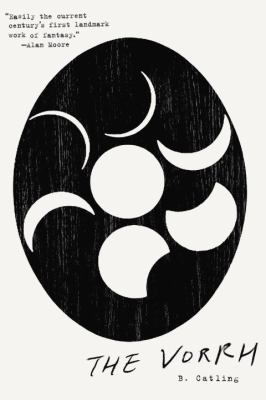
The Vorrh
- List Price: $20.00
- Binding: Paperback
- Publisher: Knopf Doubleday Publishing Group
- Publish date: 05/05/2015
Description:
Excerpted from Chapters Two and Three Chapter Two Ishmael was not a normal human, but he didn''t know this because he had never seen one. He was raised by the Kin--Abel, Aklia, Seth, and Luluwa--gentle, dark-brown machines that nurtured him from infant to child, child to adolescent. They looked like him in shape but were made from a different material. He had grown in their quiet, attentive care, knowing he was not the same but never dreaming that he was a monster. There were no monsters in his world, deep under the stables in the old city of Essenwald. Essenwald was a European city, imported piece by piece to the Dark Continent and reassembled in a vast clearing made in the perimeter of the forest. It was built over a century and a half, the core of its imitation now so old that it had become genuine, while the extremes of weather had set about another form of fakery, forcing the actions of seasons through the high velocity of tropical tantrum. Many of the old stone houses had been shipped in, each brick numbered for resurrection. Some of the newer mansions and warehouses had taken local materials and copied the ornate, crumbling splendour of their predecessors, adding original artistic brilliance in their skeuomorphic vision of decay. It was prosperous, busy, and full of movement, with solid roads and train lines scrolling out from its frantic, lustrous heart. Only one track crawled into the dark interior of the forest. Into the eternal mass of the Vorrh. For years, it was said that nobody had ever reached the centre of the Vorrh. Or, if they had, then they had never returned. Business expanded and flourished on its southernmost outskirts, but nothing was known of its interior, except myth and fear. It was the mother of forests; ancient beyond language, older than every known species, and, some said, propagator of them all, locked in its own system of evolution and climate. The banded foliage and vast trees that breathed its rich air offered much to humans but could also devour a thousand of their little lives in a microsecond of their uninterrupted, unfathomable time. So vast was its acreage, it also made its demands of time, splitting the toiling sun into zones outside of normal calibration; a theoretical traveller, passing through its entire breadth on foot, would have to stop at its centre and wait at least a week for his soul to catch up. So dense was its breathing, it dented the surrounding climate. Swirling clouds interacted with its shadow. Its massive transpiration sucked at the nearby city that fed from it, sipping from the lungs of its inhabitants and filling the skies with oxygen. It brought in storms and unparalleled shifts of weather. Sometimes it mimicked Europe, smuggling a fake winter for a week or two, dropping temperatures and making the city look and feel like its progenitor. Then it spun winds and heat to make the masonry crack after the tightness of the impossible frost. No planes dared fly over it. Its unpredictable climate, dizzying abnormalities of compass, and impossibilities of landing made it a pilot''s and navigator''s nightmare. All its pathways turned into overgrowth, jungle, and ambush. The tribes that were rumoured to live there were barely human--some said the anthropophagi still roamed. Creatures beyond hope. Heads growing below their shoulders. Horrors. The logging roads skirted its perimeter, allowing commerce to gingerly nibble at its unprotected edges. There were no commercial means of ingress or egress from its solid shadow, except for the train. The mindlessly straight track that ran towards its heart was laid, line by line, with the hunger for wood. As it grew forwards, it forgot its immediate past. The iron rail carried sleep in its miles of repetition. Most of the train that ran on it was composed of open platform and iron chain, built to receive the freshly cut trunks. But there were two passenger carriages, made for short and necessary visits or for those whose curiosity outstripped their wisdom. There were also the slave carriers, basic boxes on wheels designed to carry the workforce into the forest''s interior. The slaves had changed before the eyes of their owners. They had transformed into other beings, beings devoid of purpose, identity, or meaning. In the beginning, it was thought their malaise was the product of their imprisonment, but it soon became clear there was no personality left to feel or suffer such subtleties of emotion. The forest itself had devoured their memory and resurrected them as addicts. The city of Essenwald fed on the trees, consuming the myriad of different species that ferociously grew there. Sawmills and lumberyards buzzed and sang in the daylight hours, rubber works cooked sap into objects, and paper mills boiled and bleached the bodies naked, ready for words. All this appetite was allowed by the forest. It encouraged the nibbling at one of its edges and used it as another form of protection--a minor one in comparison to the arsenal of defence that kept the Vorrh eternal. Essenwald''s declaration of power and continuance was written throughout the twisting streets, like a labyrinthine manuscript. One such crooked causeway was called Khler Brunnen, its handwritten name nailed high on its sunless side. A house of significant age stood at its middle; its core was among the first to arrive and be sunken into the heated ground, on the site of a more sacred enclosure that some said was older than humanity itself. Parts of its later exterior had been copied in anthracite-rich stone, mined from a long-extinct quarry. Its proportion and whereabouts were stolen from one of the bitter-clad cities of northern Saxony. Its windows were shuttered. It quietly brooded, while deflecting any attention. Its small, neat stables contained three horses, a polished carriage, and a working cart. Cobbles and straw gave movement and scent to its courtyard''s stillness, while far below, beneath the blue and yellow, the brown ones hummed and fussed over the white thing they grew. The air was filled with their scent of ozone and phenol and the slight singeing of their overly warm bodies, an odour of life that led to cracking and brittleness, emitting its own distinctive hum, in the same way we age with wrinkles and softening. Four Khler Brunnen wanted to be empty. The house thought it had completed its business with full-time occupancy many years before. Yet while the house contained no people in the poised hollowness of its rooms above ground, in its basement was a well of astonishing depth--if it were ever given sky, it would reflect the most distant galaxies in its sightless water. The old, dark house was always alert and guarding what occurred beneath it. There, under 4 Khler Brunnen, among the crated machines and stagnant presses, boxed carboys and empty, stained vessels, Ishmael was becoming a man. His docile white body was beginning to toughen and shape itself for a different purpose, though it would never be as hard as the Kin. He was made of flesh, like the animals, and they were made of Bakelite, like the furniture. Their bodies were perfect in their gleam and the depth of their polished surfaces. Each was a unique, beautiful variation of form and appointment--he forever marvelled at their splendour, while examining the flabby imprecision of his own shell. Over time, he had become more and more intrigued by Luluwa; she was unlike the others. Not because she was female. That had been explained to him before. There were four kinds of things like him in this world: men, women, animals, and ghosts. He was a man, like Abel and Seth. Luluwa was a woman, like Aklia. He was just a different kind. Men had tubes and strength, women had pouches and gentleness. He had a little of all. He had first felt heat for Luluwa when she killed an animal for him. Snapping it in her long, shiny fingers, she had opened it for him to taste and smell and had explained that its insides were a copy of his, made in the same materials, unlike her own, which were modelled from a different substance. She had described how the thick, soft covering kept the animal warm, and that in time, he, too, would have such, and that if he looked carefully near the lamp he might see tiny traces of growth already there on his pliant skin. She had extended her smooth, graceful arm and shown him the absence of "hair." He had flushed, felt ashamed and badly made. He''d wanted to hold his breath and suck all the traces of animal back into his shell, wanted every hair to shrivel and glaze over, towards her perfection. She had explained before that he was too soft to grow, to expand from the inside out, to puff up. She was fully formed and inflexible. This made no sense to him--why would he have to grow into something while she was already there, immaculate? She tapped her brown shell and said that her skin was stiff and brittle while his was pliant and cuttable, that they were both vulnerable in different ways. She touched the back of his neck, stroking him with two perfect fingers, reassuring him of his place, his distinction, and her affectionate acceptance. The solidity and coolness of her touch excited him and tightened his lukewarm softness into tumescent mimicry. She pretended not to notice and drifted away from his shock on a wave of ductile clicks and internal hisses, sounds he would remember throughout his tangled life. He lifted his gaze from his awkward lap to watch her move across the long room. Her walk was purposeful, smooth, and exact, as if each of the hundreds of minor adjustments needed for propulsion and balance was consciously thought about, carefully considered in fractions of time that were impossible to contemplate. He knew if he thought ab
Expand description
Product notice
Returnable at the third party seller's discretion and may come without consumable supplements like access codes, CD's, or workbooks.
| Seller | Condition | Comments | Price |
|
Evergreen Goodwill
|
Good

|
$2.62
|
|
Goodwill of Colorado
|
Good
|
$2.77
|
|
HPB-Red
|
Good
|
$3.37
|
|
Goodwill Books
|
Good
|
$3.77
|
|
HPB-Ruby
|
Very Good
|
$4.50
|
|
HPB Inc.
|
Very Good
|
$4.78
|
|
HPB-Ruby
|
Very Good
|
$5.06
|
|
HPB-Diamond
|
Very Good
|
$5.06
|
|
HPB-Emerald
|
Very Good
|
$6.21
|
|
BooksRun
|
Good
|
$6.56
|
|
HPB-Diamond
|
Very Good
|
$6.57
|
|
HPB Inc.
|
Very Good
|
$6.57
|
|
HPB Inc.
|
Very Good
|
$7.18
|
|
HPB-Emerald
|
Very Good
|
$7.63
|
|
HPB Inc.
|
Very Good
|
$7.63
|
|
BooksRun
|
Good
|
$7.76
|
|
HPB-Ruby
|
Very Good
|
$8.08
|
|
HPB-Emerald
|
Very Good
|
$8.08
|
|
HPB-Emerald
|
Very Good
|
$8.98
|
|
HPB-Diamond
|
Very Good
|
$8.98
|
|
HPB Inc.
|
Very Good
|
$8.98
|

Please Wait