
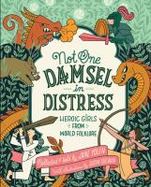
Not One Damsel in Distress : Heroic Girls from World Folklore
- Binding: Hardcover
- Publisher: Houghton Mifflin Harcourt Publishing Company
- Publish date: 07/10/2018
Description:
An Open Letter to My Daughter and Granddaughters THIS BOOK IS FOR YOU. It''s for you because I never had this book when I was growing up. In those days, I played in New York City''s Central Park with my brother Steve and my best friend, Diane. We acted out our own version of Camelot. I was always King Arthur or Merlin or sometimes Lancelot because I''d never heard of Bradamante, and Guinevere was no fun at all--just kissing and sneaking around. Or we played at Sherwood Forest, and I was Robin Hood because Maid Marian wasn''t much of an archer. This book is for you because for the longest time I didn''t know that girls could be heroes too. Not heroines. Not sheroes (a word Maya Angelou made up). Besides, heroines and sheroes sound like lesser or minor heroes, just as poetess and authoress and aviatrix sound as if they aren''t as good as their male counterparts. This book is for you because in it are folktales about regular sword-wielding, spear-throwing, villain-stomping, rescuer-type heroes who also just happen to be female. About women who use weapons or their wits or a combination of both to get away from danger or disaster. Stories that range from the medieval armored knight Bradamante to the magic-wielding African Nana Miriam, from the Jewish pirate princess to the serpent-slaying daughter of a Japanese samurai. Female heroes existed well before Wonder Woman, or Bat Girl, or Raven. Before Princess Leia Organa, Katniss Everdeen, or Storm. But they lay hidden in the back storeroom of folklore, put away by retellers and bookmakers who thought girls should be . . . well, girls. So the tales were disguised. Mutilated. Truncated. The female heroes'' feet bound as surely as the Chinese bound the feet of young noblewomen even as late as the last century. This book is for you because the stories were not only waiting there to be rediscovered in folklore, but in real life, too. For once upon a real time, there were actually young women who--sometimes in full disguise, and other times in no disguise at all--went off to battle as often as young women do who are in the armed forces now. For example, there were the Amazons--goddess-worshiping all-female tribes in Greece and North Africa. These women warriors were said to have been the first to tame horses, which made them invincible in battle. They were known as founders of cities and sanctuaries. According to David E. Jones in Women Warriors: A History , the Amazons wore long trousers, midthigh-length coats, leather boots, and Phrygian hats. Sometimes they used war spears and bows. One group of Amazons called the Scythians wouldn''t let their girls be married until they''d killed three enemies in battle. More than a few barbarian armies in the long ago included women warriors and battle queens. If you look in the Bible, you will find the seeress and judge Deborah leading troops into battle. Jael and Judith, who slew enemy generals. Or in Arabic texts you can read about Queen Bat Zabbai, who hunted with the best of the men and, well-armored, led her armies against Egypt. Ancient texts are full of such tough-minded women. So too are the European histories: Graine or Grania O''Malley, the Irish pirate queen who lived in the Elizabethan era. Joan of Arc. Queen Maud, who led an army against her usurping cousin in Britain in the twelfth century. The Celtic Queen Boudica who led an uprising against the Roman overlords in 60-61 CE. There was even a fabulous hidden history from the fourteenth century, about noble English women who fought in their own tournaments alongside the knights. A chronicle from that time states, "When the tournaments were held, in every place a company of ladies appeared in the diverse and marvelous dress of a man, to number sometimes about forty, sometimes fifty ladies." Though the chronicle quickly adds, rather bitterly, "And in such manner they spent and wasted their riches and injured their bodies with abuses and ludicrous wantoness." It must be pointed out that the men were not equally shamed by the chronicles for doing the exact same thing! In China lived Asia''s most famous woman warrior, the fifth-century Hua Mu-Lan, who replaced her ill father in the emperor''s army. Likewise, Madame Ching, the nineteenth-century pirate, commanded two thousand ships and seventy thousand sailors after her husband died. In the Beja tribe of Africa, there was a corps of women lancers, and in the 1840s, a battalion of spear women who protected the king of Behr. The African Yoruba people have a long tradition of female military heroes. Native American tribal histories are full of similar stories. There was a secret society of Cheyenne women warriors and the famed Crow warrior Woman Chief, who battled their traditional enemy, the Blackfoot tribe. Meanwhile, the Blackfoot people had their own Brown Weasel, later called Running Eagle, who learned hunting and warfare from her brother. I never knew their names or their stories when I was your age. Not in real life, not in folklore. But I do now. And so do you. This book is for you because I believe that the tongue is mightier than the sword. As is the pen. Most of the time. But this book is also for you because it''s important to know that anyone can be a hero if they have to be. To right wrongs. To help those in need. To fight for justice. Even girls. Especially girls. Especially you. GREECE Atalanta the Huntress Hail Artemis, goddess of the hunt, patron of young women warriors THERE WAS A KING named Iasus, a cruel, unfeeling man who took his newborn daughter into the Calydonian forest on the far borders of his kingdom. There he put her down on the forest floor saying, "I wished for a boy, and this is what I got. I will not have you." Then he turned and left. The child lay under the canopy of leaves and after a while, growing hungry, she began to cry. It was the high wail of an infant who wants only one thing. A mother bear happened to pass by. Curious about that strange yet familiar cry, she came over and snuffled at the child--great furry head against the smooth one. Unafraid, the child reached up and touched the bear''s nose. In return the bear began to lick her with a rough, tickly tongue. For a moment the child forgot her hunger and cooed with delight. And the bear, charmed by the cooing sound, lay down heavily by the baby''s side. The bear had just weaned her own cubs, but here was a cub of another sort. So without quite understanding the why of it, she offered her milk to the human cub. The baby drank, slept, woke, cooed, drank again. And lived. EVENTUALLY THE BEAR was ready to wean the human cub, but the human cub would not let her go, trotting through the woods after the bear with incredible speed. And so a year went by, and then a second. In the third year the bear went missing--the child never knew why--and a passing hunter heard the child weeping, picked her up, and brought her home to his childless wife. "We shall call this little girl Atalanta," the hunter said. "And she will be a blessing to us in this, our old age." "We will give honor to Artemis, goddess of the hunt," added his wife, "who preserved her in the forest until you could find her." And so they took Atalanta in and taught her woodcraft and house craft, hunting and cooking. She was as easy in the woods at thirteen as she had been at three: swift, eagle-eyed, and strong. NOW, WHEN ATALANTA was thirteen, her stepparents died. She went at once to Artemis''s shrine in the forest and knelt down. If she had no mother, Artemis would be her mother. If she had no father, Artemis would watch over her. "Tell me, goddess," she whispered, "what I must do now." "Disaster will follow the men you meet," came the reply. "Then I shall stay away from the company of men," said Atalanta. BUT IT WAS EASIER to say this than to do it, for the Calydonian forest was home to a great red-eyed boar. That monster had been set down by Artemis, who was angered that King Oeneus of Calydon had neglected to give her honor. The boar tore down the grapevines, ate the olives from the trees, trampled the green corn, and slaughtered sheep in their pens. Neither shepherd nor sheepdog nor farmer could stand against the beast. Soon the storehouses of Calydon stood empty and the country-people fled to the sa
Expand description
Product notice
Returnable at the third party seller's discretion and may come without consumable supplements like access codes, CD's, or workbooks.
| Seller | Condition | Comments | Price |
|
Zoom Books East
|
Good |
$1.46
|
|
Dream Books Co.
|
Good

|
$3.57
|
|
ClickGoodwill
|
Good
|
$3.65
|
|
HPB Inc.
|
Very Good
|
$7.18
|
|
HPB-Ruby
|
Very Good
|
$7.31
|
|
Firefly Bookstore
|
Very Good
|
$10.67
|
|
ErgodeBooks
|
Good |
$14.82
|
|
Bonita
|
Good
|
$32.93
|
|
Just one more Chapter
|
New |
$65.36
|

Please Wait